What gemstone therapy claims
Vedic gemstone therapy (ratna chikitsa) holds that each graha corresponds to a gemstone, and that wearing the right stone in contact with the skin strengthens that graha's influence in your life.
The stated mechanism is that a stone filters and transmits the particular quality of light or energy associated with its planet. That is the traditional claim; there is no established physical mechanism behind it, and this guide will be straightforward about that throughout.
It is also, by a wide margin, the most expensive branch of practical astrology and the one with the most severe conflict of interest — because the person diagnosing you very often sells the cure.
The nine stones
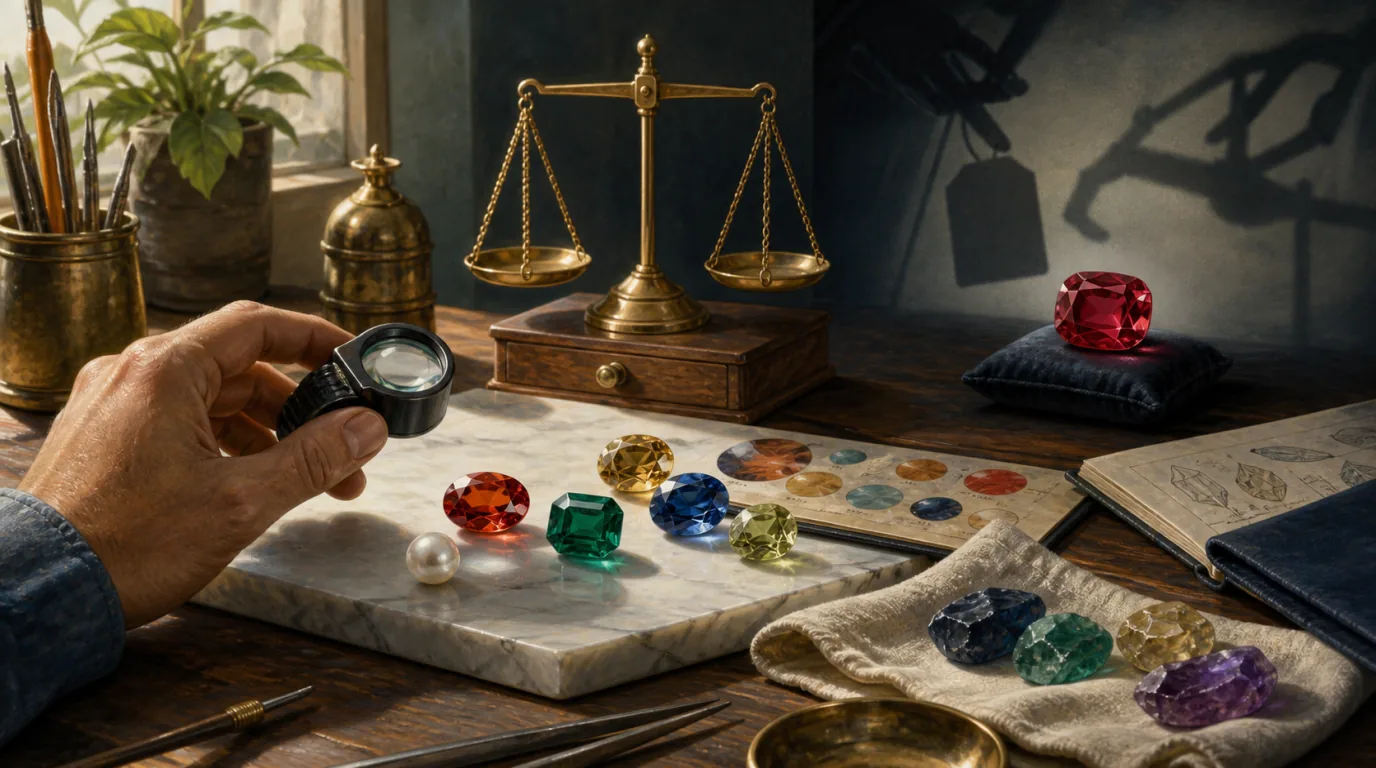
| Graha | Primary stone | Common substitutes | Metal / finger |
|---|---|---|---|
| Sun | Ruby (manik) | Red garnet, red spinel | Gold · ring finger |
| Moon | Natural pearl (moti) | Moonstone | Silver · little finger |
| Mars | Red coral (moonga) | Carnelian | Gold or copper · ring finger |
| Mercury | Emerald (panna) | Green tourmaline, peridot | Gold · little finger |
| Jupiter | Yellow sapphire (pukhraj) | Citrine, yellow topaz | Gold · index finger |
| Venus | Diamond (heera) | White sapphire, zircon | Silver or platinum · middle finger |
| Saturn | Blue sapphire (neelam) | Amethyst, lapis lazuli | Silver or iron · middle finger |
| Rahu | Hessonite (gomed) | Orange zircon | Silver · middle finger |
| Ketu | Cat's eye (lehsunia) | Chrysoberyl | Silver · little finger |
Substitutes (upratna) are traditionally considered weaker but acceptable, and they cost a fraction of the primary stone. Any practitioner who insists only the primary stone will do — for a stone costing several months' income — is worth questioning on exactly that point.
How a proper prescription is supposed to work
This is the part that separates a considered recommendation from a sales pitch, and it has almost nothing to do with your rashi.
1. It requires a full birth chart. Date, time and place. A stone recommended from your moon sign or date of birth alone is not a prescription — it is a guess applied to one twelfth of the population. Birthstone vs rashi ratna sets the month list, the rashi table and the chart rule side by side.
2. It depends on functional benefic status. The central question is which houses the graha rules from your ascendant. A graha ruling favourable houses for your lagna is a candidate for strengthening; one ruling difficult houses is generally not. This is why the same stone is right for one person and wrong for another with the same moon sign.
3. Strengthen the strong, not the weak. The most common misunderstanding. Classical practice generally does not recommend strengthening a graha that is functionally malefic for you — that amplifies the difficulty. Yet "your Saturn is weak, wear neelam" is the most frequently heard advice in the field, and it inverts the logic.
4. Timing matters. Traditionally a stone is most relevant during the dasha of the graha concerned, and is often set aside afterwards.
The stones that are trialled first
Tradition itself flags three as fast-acting and unpredictable, and prescribes a trial period rather than immediate permanent wear:
- Blue sapphire (Saturn) — the most cautioned stone in the entire tradition. Standard practice is to wear it tied to the skin for three to seven days and watch for a reaction before setting it in a ring.
- Hessonite (Rahu) — same caution.
- Cat's eye (Ketu) — same.
This deserves a sceptical note that cuts both ways. The trial convention is genuinely classical, so a practitioner recommending it is following the tradition properly. But it also creates an unfalsifiable structure: if things go well the stone worked, if badly the stone was wrong for you. Be aware of the shape of that argument.
Yellow sapphire and emerald are conventionally regarded as the safest, which is one reason they are recommended so freely.
How the money works
Understand the economics and most of the risk disappears.
Price scales with weight and quality, steeply. A natural unheated blue sapphire of good colour runs into lakhs. A treated or lower-grade stone of identical appearance to an untrained eye costs a small fraction. The visual difference is often negligible; the price difference is not.
The diagnosis and the sale are usually the same transaction. If your astrologer also supplies the stone, they have a direct financial interest in your needing an expensive one. That does not make them dishonest — it does mean you should get the recommendation and the purchase from different people.
Certification is the minimum. Insist on a report from a recognised independent gemmological laboratory stating species, origin and treatments. Verify the certificate with the lab directly, not through the seller.
Watch for the escalation pattern: a free or cheap reading, an urgent problem identified, and a stone priced at what the practitioner estimates you can pay. Urgency is the tell — no classical text says a gemstone must be bought this week.
What gemstones cannot do
Directly: no controlled evidence shows that wearing a gemstone affects health, wealth, relationships or any measurable outcome. No study has demonstrated an effect. This guide is not going to imply otherwise.
Three specific cautions. Never substitute a gemstone for medical treatment — this is where the practice causes real harm, and no responsible practitioner endorses it. Never take a loan to buy one. And be aware that whatever benefit people report is fully consistent with a placebo effect plus the ordinary confidence that follows an expensive commitment — which is a real effect, but not one that requires the stone to be genuine or correctly chosen.
The cheaper alternatives the tradition offers
Worth knowing that classical remedial practice does not lead with gemstones. It lists several categories, and the stone is the costliest and least emphasised:
- Mantra — repetition of the graha's mantra. Free.
- Daan — charity of items associated with the graha, on its weekday. Cheap.
- Behavioural remedies — the discipline associated with the graha. Free, and the one with the most obvious mechanism.
- Fasting on the graha's day.
- Rudraksha — far less expensive than gemstones.
If someone jumps straight to a lakh-rupee stone without mentioning any of these, that is informative about their priorities.
If you still want one
Get your chart read by someone who does not sell stones. Ask which houses the graha rules from your ascendant and why strengthening it helps. Ask about a substitute. Buy certified, from a separate seller. Start with a trial for the three cautioned stones. And treat it as a meaningful object rather than an investment or a treatment.
Run your free birth chart first — you need the ascendant and house rulerships before any of this is meaningful. See the navagraha guide for what each graha signifies and the dignity guide for how strength is actually assessed.
Astrology here is a framework for reflection and planning — not medical, legal or financial advice. Never delay medical treatment.
Frequently asked questions about Jyotish gemstones
Can I choose a gemstone from my Sun sign?
That is too little information for a traditional prescription. Practitioners usually examine the ascendant, house ownership, dignity and running dasha before deciding whether a planet should be strengthened.
Is a larger gemstone always better?
No. Size is not evidence that a stone suits the chart, and price does not prove an astrological effect. Set a budget before speaking to a seller and avoid guaranteed claims.
Can a gemstone replace medical or financial advice?
No. Gemstones are traditional symbolic remedies. They cannot diagnose illness, protect an investment or substitute for professional care.