Nine grahas, not nine planets
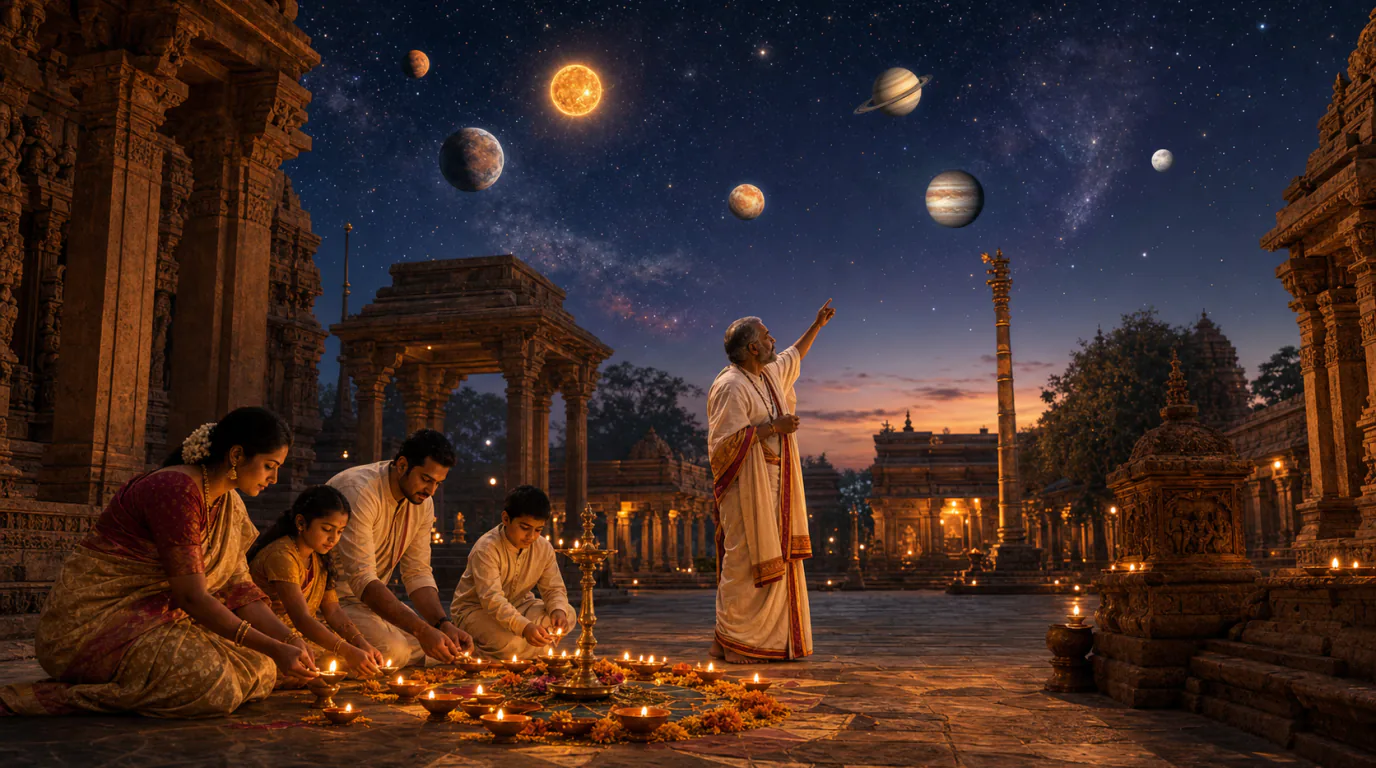
Jyotish reads nine bodies: the Sun, Moon, Mars, Mercury, Jupiter, Venus, Saturn, Rahu and Ketu. The Sanskrit word is graha, which means "seizer" or "one that grasps" rather than "planet" — a distinction that matters, because two of the nine are not physical objects at all.
Rahu and Ketu are the lunar nodes: the two points where the Moon's orbital path crosses the Sun's apparent path. They are mathematical intersections. Eclipses happen when a new or full moon occurs near one of them, which is exactly why the tradition treats them as the shadow bodies that swallow the luminaries.
You will also notice who is missing. Uranus, Neptune and Pluto are not part of classical Jyotish. Some modern practitioners incorporate them; the classical texts and the entire dasha system do not. We follow the nine-graha tradition.
What each graha signifies
| Graha | Signifies | Rules | Day |
|---|---|---|---|
| Surya (Sun) | Soul, vitality, father, authority, bone and eyes | Simha | Sunday |
| Chandra (Moon) | Mind, emotion, mother, memory, fluids | Karka | Monday |
| Mangal (Mars) | Energy, courage, siblings, property, blood, conflict | Mesha, Vrischika | Tuesday |
| Budh (Mercury) | Intellect, speech, commerce, skin, nerves | Mithuna, Kanya | Wednesday |
| Guru (Jupiter) | Wisdom, teachers, children, wealth, expansion | Dhanu, Meena | Thursday |
| Shukra (Venus) | Relationships, comfort, art, vehicles, reproduction | Vrishabha, Tula | Friday |
| Shani (Saturn) | Discipline, delay, labour, longevity, bones | Makara, Kumbha | Saturday |
| Rahu | Obsession, foreign things, technology, sudden rise | — | — |
| Ketu | Detachment, research, spirituality, sudden loss | — | — |
Rahu and Ketu own no signs of their own. Most schools read them through the sign they occupy and its ruler; a few assign them co-rulership of Kumbha and Vrischika respectively. This is a genuine divergence, not a settled rule.
Benefic and malefic — and why the labels mislead
Grahas are conventionally sorted into natural benefics (Jupiter, Venus, waxing Moon, well-associated Mercury) and natural malefics (Saturn, Mars, Sun, Rahu, Ketu, waning Moon).
This is the most misread idea in the whole system. "Malefic" does not mean bad and "benefic" does not mean good. The classical sense is closer to how a graha operates: malefics work by friction, pressure and removal; benefics work by ease, growth and protection. Pressure is not the enemy of a good life — nothing difficult is ever built without it.
Two refinements matter more than the base labels:
Functional status beats natural status. Whether a graha helps you specifically depends on which houses it rules from your ascendant. Saturn is a natural malefic, but for a Vrishabha or Tula ascendant it rules favourable houses and is treated as a strong ally. This is why generic "Saturn is bad" advice is worthless without knowing your lagna.
Dignity changes behaviour. A graha in its own sign or exalted acts confidently; debilitated it acts under strain. Same graha, different mode. The exaltation and debilitation guide covers the full table.
Relationships between grahas
Grahas are read as having permanent friendships and enmities, which shapes how they behave in each other's signs.
- Sun — friends: Moon, Mars, Jupiter. Enemies: Venus, Saturn.
- Moon — friends: Sun, Mercury. No permanent enemies.
- Mars — friends: Sun, Moon, Jupiter. Enemy: Mercury.
- Mercury — friends: Sun, Venus. Enemy: Moon.
- Jupiter — friends: Sun, Moon, Mars. Enemies: Mercury, Venus.
- Venus — friends: Mercury, Saturn. Enemies: Sun, Moon.
- Saturn — friends: Mercury, Venus. Enemies: Sun, Moon, Mars.
The pattern is not random: the luminaries and Jupiter cluster together, while Venus and Saturn cluster on the other side. Note especially that the Moon has no permanent enemies — consistent with its role as the receptive, adaptive mind.
On top of these permanent relations sits a temporary layer based on how close two grahas currently sit to each other. Combining both gives the five-fold scale used in strength calculations.
Combustion — when a graha is too close to the Sun
A graha within a certain distance of the Sun is said to be asta or combust, and is traditionally read as weakened — its significations obscured by the Sun's glare, much as a star is invisible at noon.
Mercury and Venus are combust most often, simply because they never stray far from the Sun. That is astronomy, not misfortune, and treating every combust Mercury as a defect would flag a large share of the population. See the combustion guide for the orbs and the cazimi exception, where a graha at the Sun's exact degree is read as empowered rather than burnt.
Remedies, and a caution
Each graha has traditional remedies: a weekday, a mantra, a charity, a gemstone. The behavioural ones are harmless and occasionally useful — Saturday service for Saturn, Thursday study for Jupiter.
Gemstones deserve a warning. A proper prescription depends on whether the graha is functionally benefic for your ascendant and how it is placed, which requires an actual chart. Blue sapphire (Saturn) and hessonite (Rahu) are traditionally considered fast-acting and are the ones most often sold on fear. No gemstone should be bought on the strength of a rashi alone, and none substitutes for medical treatment. Our gemstone guide covers what the tradition actually claims.
See your own nine
The useful next step is looking at where the nine sit in your own chart — sign, house, dignity and aspects together, since no graha is read in isolation.
The free birth chart calculator shows all nine with their positions and dignities from Swiss Ephemeris data, and the twelve houses guide explains the area of life each placement lands in.
Each of the nine also has its beej mantra, traditional japa count and day in the mantra library, with the next hora of that graha in your city.
Astrology here is a framework for reflection and planning — not medical, legal or financial advice.
Frequently asked questions about the navagrahas
Why are Rahu and Ketu called grahas if they are not planets?
Graha is a Jyotish category, not the modern astronomical word for planet. Rahu and Ketu are the calculated lunar nodes where eclipses can occur, and the tradition treats them as chart factors.
Does a natural malefic always give bad results?
No. House ownership, dignity, aspects, conjunctions and the running dasha all change the reading. Saturn or Mars can support discipline and effort in one chart while putting pressure on another area.
Which graha is most important in a Kundli?
There is no universal winner. The lagna lord, Moon, Sun, dasha lord and the ruler of the house being examined may each lead for a different question.