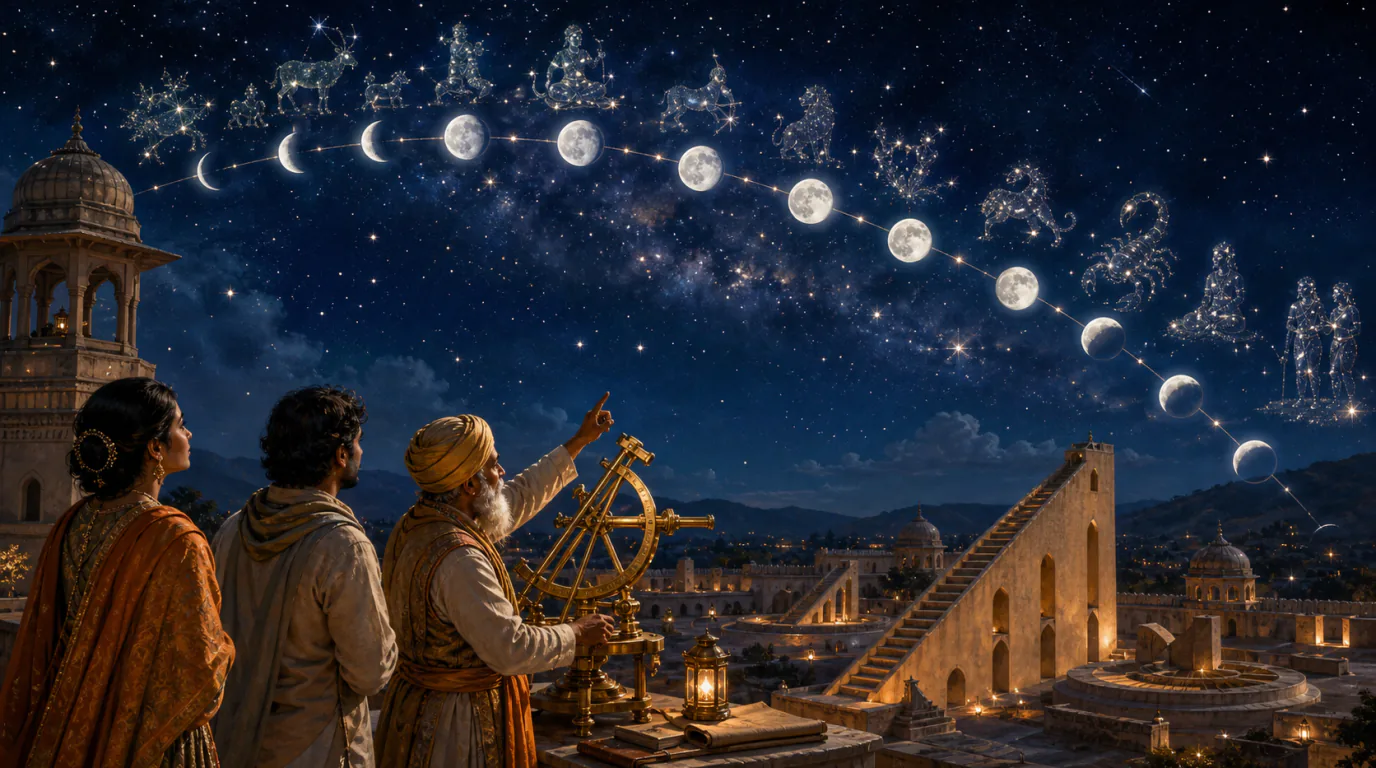
What a rashi is
A rashi is one of twelve 30° divisions of the zodiac. Twelve times 30° is 360°, and the names map onto the familiar zodiac signs — Mesha is Aries, Vrishabha is Taurus, and so on.
The complication, and the single most common confusion in Indian astrology, is which body you are measuring. In Western astrology "your sign" means the sign the Sun was in. In Vedic astrology "your rashi" almost always means the sign the Moon was in. Same zodiac, different planet, usually a different answer.
There is a second difference layered on top: Vedic astrology uses the sidereal zodiac, measured against the fixed stars, while Western astrology uses the tropical zodiac, measured from the spring equinox. The two have drifted roughly 24° apart. Even comparing Sun to Sun, the sidereal answer is often one sign earlier.
Between the two effects, most Indians have a rashi that differs from the Western sun sign they grew up quoting. That is expected, not an error. Finding your rashi walks through the calculation.

The twelve rashis
| Rashi | English | Ruler | Element | Traditional temperament |
|---|---|---|---|---|
| Mesha | Aries | Mars | Fire | Direct, quick to start, competitive |
| Vrishabha | Taurus | Venus | Earth | Steady, sensory, resistant to being rushed |
| Mithuna | Gemini | Mercury | Air | Verbal, curious, quick to adapt |
| Karka | Cancer | Moon | Water | Protective, memory-driven, home-centred |
| Simha | Leo | Sun | Fire | Dignified, wants to be seen, generous |
| Kanya | Virgo | Mercury | Earth | Analytical, exacting, service-minded |
| Tula | Libra | Venus | Air | Balancing, relational, decision-averse |
| Vrischika | Scorpio | Mars | Water | Intense, private, all-or-nothing |
| Dhanu | Sagittarius | Jupiter | Fire | Philosophical, blunt, freedom-seeking |
| Makara | Capricorn | Saturn | Earth | Patient, duty-bound, slow and durable |
| Kumbha | Aquarius | Saturn | Air | Systemic, unconventional, detached |
| Meena | Pisces | Jupiter | Water | Absorptive, imaginative, boundary-poor |
Note that Mars, Venus, Mercury, Jupiter and Saturn each rule two signs, while the Sun and Moon rule one each. That asymmetry is structural, not an oversight — the two luminaries were treated as a distinct category.
Why the Moon and not the Sun
The Moon in Jyotish signifies manas — mind, emotion, memory, the part of you that reacts before you think. The reasoning behind privileging it is that day-to-day life is largely governed by that layer.
There is also a practical reason. The Moon moves about 13° a day and changes sign every two and a quarter days, so the Moon sign discriminates far more finely than the Sun, which sits in one sign for a month. A framework built on the Moon simply carries more information per person.
The Sun is not ignored — it signifies soul, vitality, father and authority, and has its own house and dignity analysis. It is just not what "my rashi" refers to.
The four classification schemes that actually get used
Beyond the individual meanings, rashis are grouped, and the groupings do most of the analytical work.
- Element — fire, earth, air, water, repeating in that order. Signs sharing an element are traditionally considered compatible.
- Modality — chara (movable: Mesha, Karka, Tula, Makara), sthira (fixed: Vrishabha, Simha, Vrischika, Kumbha) and dvisvabhava (dual: Mithuna, Kanya, Dhanu, Meena). This is used heavily in timing and in muhurta — movable signs for travel and change, fixed signs for anything meant to last.
- Odd and even — odd signs are classed masculine and active, even signs feminine and receptive. Used in matching and in divisional chart calculation.
- Rising type — whether a sign rises head-first, back-first or both. It sounds obscure but drives real muhurta rules.
Where your rashi is actually used
More than most people realise. Your rashi determines which daily rashifal applies to you — and if you have been reading the Western sun-sign column, you have been reading the wrong one. It anchors gochar (transit) analysis, since transits are counted from the Moon. It sets your sade sati window, which is defined purely by Saturn's position relative to your Moon. And it feeds the 36-point matching calculation.
What a rashi will not tell you
A rashi is one twelfth of the population. It is the coarsest useful division in the system, and reading it alone is like judging a book by its genre.
Three things routinely overrule it in practice. Your lagna (ascendant) organises the entire house structure and changes every two hours, so it is far more individual — see the lagna guide. Your nakshatra subdivides the same zodiac 27 ways instead of 12. And the running dasha often explains what is happening in a life better than any static placement.
The honest framing: a rashi is a useful shared vocabulary and a reasonable starting point. It is not a personality test, it has no controlled evidence behind it, and it does not determine outcomes.
Find your rashi properly
You need date, time and place of birth. The Moon changes sign every two and a quarter days, so a date alone usually settles it — but if you were born near a sign change, the time decides.
Run the free birth chart calculator for your rashi, lagna and nakshatra together, or read what is my rashi for the calculation in detail. Then check the daily forecast against the right sign.
Astrology here is a framework for reflection and planning — not medical, legal or financial advice.
Frequently asked questions about the 12 rashis
Is rashi the same as zodiac sign?
Rashi means sign, but in everyday Jyotish it usually refers to the Moon sign. A Western zodiac sign usually means the tropical Sun sign, so the two labels often point to different placements.
Can two people with the same rashi be very different?
Yes. Rashi is one placement in a chart containing nine grahas, twelve houses, nakshatras and timing periods. It supplies useful context, not a complete personality description.
Why does my rashi change between calculators?
Check whether both calculators use the sidereal zodiac, the same ayanamsha, the same time zone and the same birth time. A Moon close to a sign boundary can move when any of those inputs differ.
Now try it on your own numbers
This guide explains the method. Open find your own rashi to run it — the page shows its working, so you can check every step against what you have just read rather than taking the result on trust.