What is Panchang?
Panchang is a daily Vedic calendar for timing. It helps answer three practical questions: what is active now, when will it change, and which available window fits the task?
The word comes from pancha (five) and anga (parts). Those five parts are Vara, Tithi, Nakshatra, Yoga and Karana. They describe the weekday, the Moon's cycle and position, and two finer Sun-Moon timing factors.
You do not need to memorise the Sanskrit names. Start with the current Tithi and Nakshatra, check the day's caution periods, then compare the time windows that are practical for what you need to do.

The five parts of Panchang
1. Vara: the weekday
Vara is the day of the week: Sunday through Saturday. Each day is traditionally associated with a planet. Monday is linked with the Moon, Tuesday with Mars, Wednesday with Mercury, and so on. Astrologers use Vara as one small clue when matching a day to an activity; it is not a verdict on the whole day.
2. Tithi: the lunar day
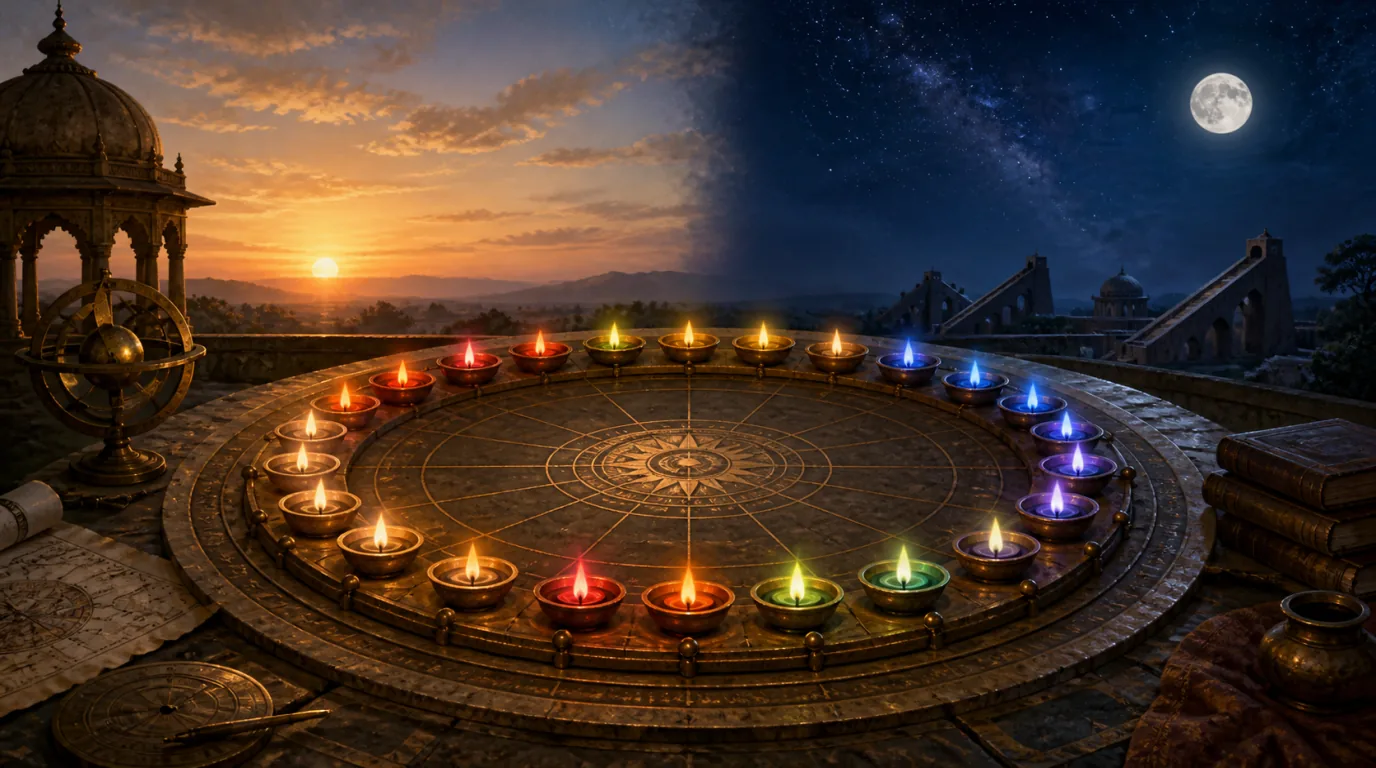
Tithi describes the changing angle between the Sun and Moon. There are 30 Tithis in a lunar month: 15 while the Moon is waxing (Shukla Paksha) and 15 while it is waning (Krishna Paksha). A Tithi does not always begin at midnight or last exactly 24 hours, so it can change during the day.
Traditional calendars associate different Tithis with different types of work. For example, some are preferred for worship, learning or celebrations, while others are used for discipline, clearing or completion. These are traditional planning guidelines, not guarantees of an outcome.
3. Nakshatra: the Moon's star sector
The sidereal zodiac is divided into 27 Nakshatras, or lunar sectors. The Moon usually moves through one Nakshatra in about a day. A detailed Panchang should also show when the Moon moves into the next one. Swarn Siddhi shows the value active at local sunrise and the first exact Nakshatra transition before the next sunrise.
In Jyotish tradition, the Nakshatra helps describe the tone of the time. Some are associated with movement, learning or creative work; others with repair, firm decisions or rest. For a personalised election, an astrologer may also compare today's Nakshatra with your birth Nakshatra.
4. Yoga: the Sun-Moon combination
Yoga is calculated from the combined sidereal positions of the Sun and Moon. There are 27 Yogas. This Panchang Yoga is a timing factor and should not be confused with physical yoga practice or with planetary combinations in a birth chart.
Traditional texts classify some Yogas as generally supportive and others as demanding. In practice, Yoga is read together with the other four parts; one favourable name does not automatically make every minute suitable.
5. Karana: half of a Tithi
A Karana is half a Tithi, so it changes more frequently. It is used when choosing a precise start time. Bava, Balava and several other Karanas are commonly treated as workable for ordinary beginnings. Vishti, also called Bhadra, is traditionally avoided for many auspicious starts, although the exact advice depends on the activity and school of practice.
A simple worked example
Imagine that today's Panchang for your city shows Monday, Shukla Panchami, Rohini Nakshatra, Siddhi Yoga and Bava Karana. A plain-language reading would be: it is a Moon-ruled weekday, the Moon is in the fifth waxing lunar day, and the remaining factors are traditionally treated as broadly supportive for constructive work.
That still does not mean every hour is equally useful. Before choosing a start time, you would check when each factor ends, avoid any relevant caution period such as Rahu Kaal, and select a window that fits the activity. A wedding, a medical appointment and sending a routine email do not require the same level of timing analysis.
Why your location and sunrise matter
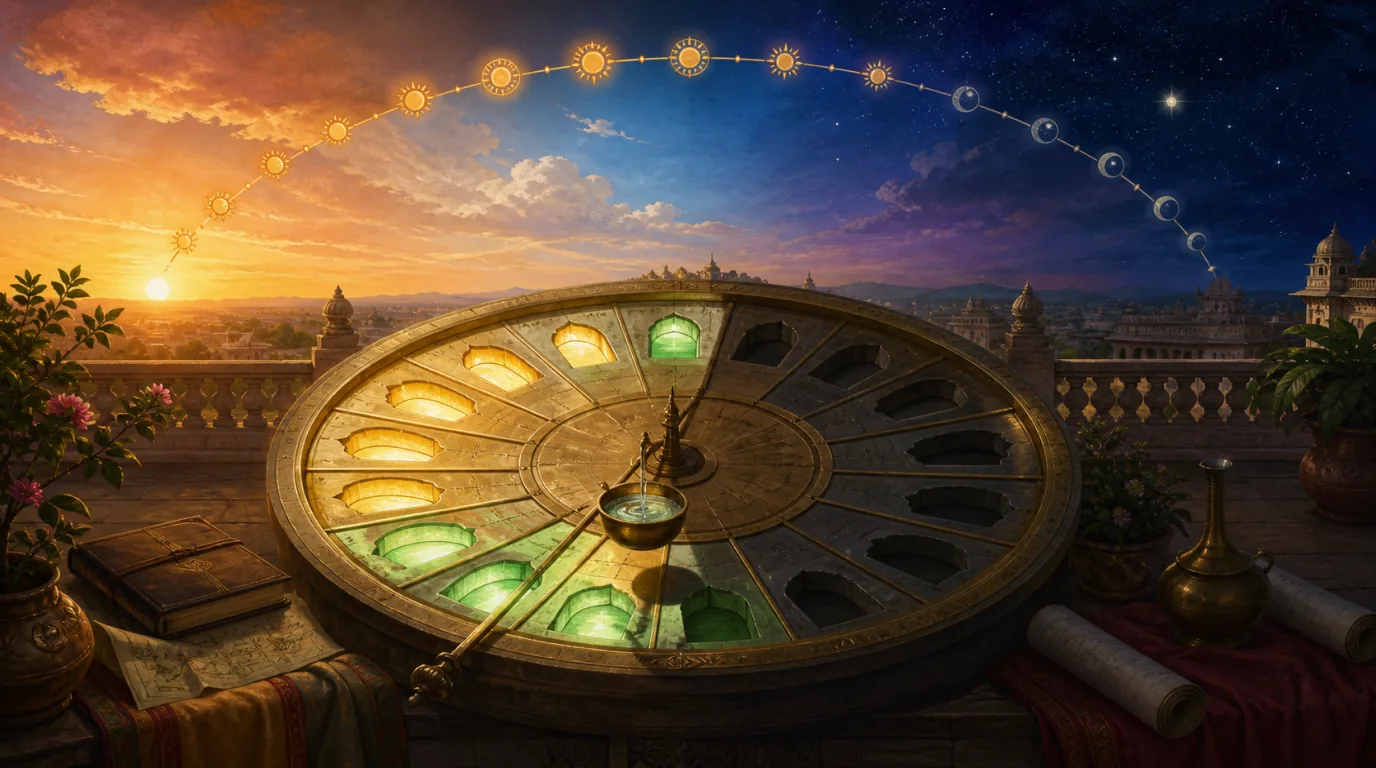
A trustworthy Panchang asks for a city because sunrise and sunset vary by latitude, longitude, date and time zone. Day and night Choghadiya, Hora and periods such as Rahu Kaal are divided from local sunrise and sunset. A time copied from another city may therefore be wrong for you.
Tithi, Nakshatra, Yoga and Karana describe astronomical relationships at a given moment, but a daily page still needs local time to show when those changes happen for you. Always check the city, date and time zone shown at the top of the result. You can see a location-specific example on the New Delhi Panchang.
Good timings and caution timings
Panchang is most useful when it helps you compare windows instead of labelling an entire day "good" or "bad." Commonly checked periods include:
- Choghadiya: broad day and night slots. Amrit, Shubh and Labh are often chosen for suitable new work; Chara is commonly used for movement or travel. Read the plain-language Choghadiya guide.
- Hora: planetary hours used to match a task with a planetary theme, such as Mercury Hora for communication. See how Hora works.
- Abhijit Muhurat: a midday period many traditions regard as supportive when a more specific Muhurat is unavailable. Local rules and exceptions still matter.
- Rahu Kaal: traditionally avoided for beginning important new ventures. Routine work can continue. Read about Rahu Kaal, Yamaganda and Gulika.
- Yamaganda and Gulika: additional periods that many traditions check before an auspicious start.
Never delay emergency care, safety action or an unavoidable responsibility because of an astrological time window. Panchang is a planning aid within a spiritual tradition, not a replacement for medical, legal, financial or safety advice.
How to use today's Panchang in five steps
- Set the correct city and date. Confirm the displayed time zone and local sunrise.
- Name the task. "Start a business" is different from "finish monthly accounts" or "leave for the airport."
- Check the five parts. Note the current Tithi, Vara, Nakshatra, Yoga and Karana, then use the transition table to see when each sunrise value changes.
- Remove unsuitable windows. Depending on your tradition and task, check Rahu Kaal, Yamaganda, Gulika and Vishti Karana.
- Compare the remaining windows. Use Choghadiya, Hora or a purpose-specific Muhurat to choose a practical time.
For important life events, a general daily Panchang is only the first filter. A full Muhurat may also consider the event, the people involved and their birth charts. For everyday planning, open today's Panchang and begin with the clearest suitable window you can realistically use.
Common Panchang misunderstandings
"One good factor makes the whole day auspicious"
No single factor should be read alone. A supportive Nakshatra can overlap a caution period, and a demanding Yoga can coexist with a practical Hora. Read the combination and the transition times.
"Everyone gets the same timings"
No. Some astronomical transitions occur at the same instant, but their displayed local time changes by time zone. Sunrise-based periods also change from city to city.
"Rahu Kaal means something bad will happen"
That is too literal. In common practice, Rahu Kaal is a traditional caution for starting an important new undertaking. It does not require you to stop normal work, cancel essential travel or fear the period.
"Panchang replaces a birth chart"
No. Panchang describes the shared timing of a place and moment. A Kundli describes planetary positions for a person's birth. Personalised timing can use both, but they answer different questions.
Frequently asked questions
Is today a good day according to Panchang?
Most days contain a mixture of supportive, neutral and caution periods. The useful question is usually "Which time today best suits this task?" Check the live values and their end times on today's Panchang.
Which of the five Panchang parts is most important?
There is no universal single winner. Tithi and Nakshatra are common starting points, while Karana becomes important for a precise beginning. The purpose of the activity decides how the factors should be weighted.
Does Panchang change by city?
Yes. Sunrise, sunset and sunrise-based periods are location-specific. The local clock time of astronomical transitions also depends on the time zone.
Can Panchang choose a wedding date?
It can identify candidate dates, but traditional wedding Muhurat selection normally uses more than the daily Panchang. It may consider both partners' charts, Tara Bala, planetary strength and local ceremony constraints.
How exact are Panchang calculations?
The astronomical positions can be calculated precisely, but published Panchangs may differ because they use different location settings, sunrise definitions, ayanamsa choices or traditional rules. Swarn Siddhi shows the city, time zone and sunrise-based schedule. It also calculates the first Tithi, Nakshatra, Yoga and Karana change after sunrise to the second and displays it in local time.