Two different questions
A birthstone answers "which gem goes with my birth month?" A Vedic ratna answers "which planet in my chart should be strengthened, and which stone is said to do that?" The first is a jewellery and gifting tradition based on the calendar. The second is a remedy in Jyotish, chosen for one person's chart, with rules about who should not wear a stone at all.
Both are traditions, and neither is proven science. But they work so differently that mixing them up leads to real mistakes, such as wearing the most cautioned stone in Vedic astrology because it happened to be your month's birthstone.
Birthstones by month
The modern birthstone list was published by American jewellers in 1912 and has been revised a few times since; tanzanite was added for December in 2002 and spinel for August in 2016. Many months now have more than one stone.
| Month | Birthstone | Other stones for the month |
|---|---|---|
| January | Garnet | — |
| February | Amethyst | — |
| March | Aquamarine | Bloodstone |
| April | Diamond | — |
| May | Emerald | — |
| June | Pearl | Alexandrite, moonstone |
| July | Ruby | — |
| August | Peridot | Spinel, sardonyx |
| September | Sapphire | — |
| October | Opal | Tourmaline |
| November | Topaz | Citrine |
| December | Turquoise | Tanzanite, zircon |
A birthstone needs nothing but your birth month. It carries no rule about who should avoid it, because it was never meant to change anything. It is a sentimental choice, and a lovely one for a gift.
The birthstone calculator gives your month's stones and shows where each one meets the nine Vedic gems.
The nine Vedic gems (navaratna)
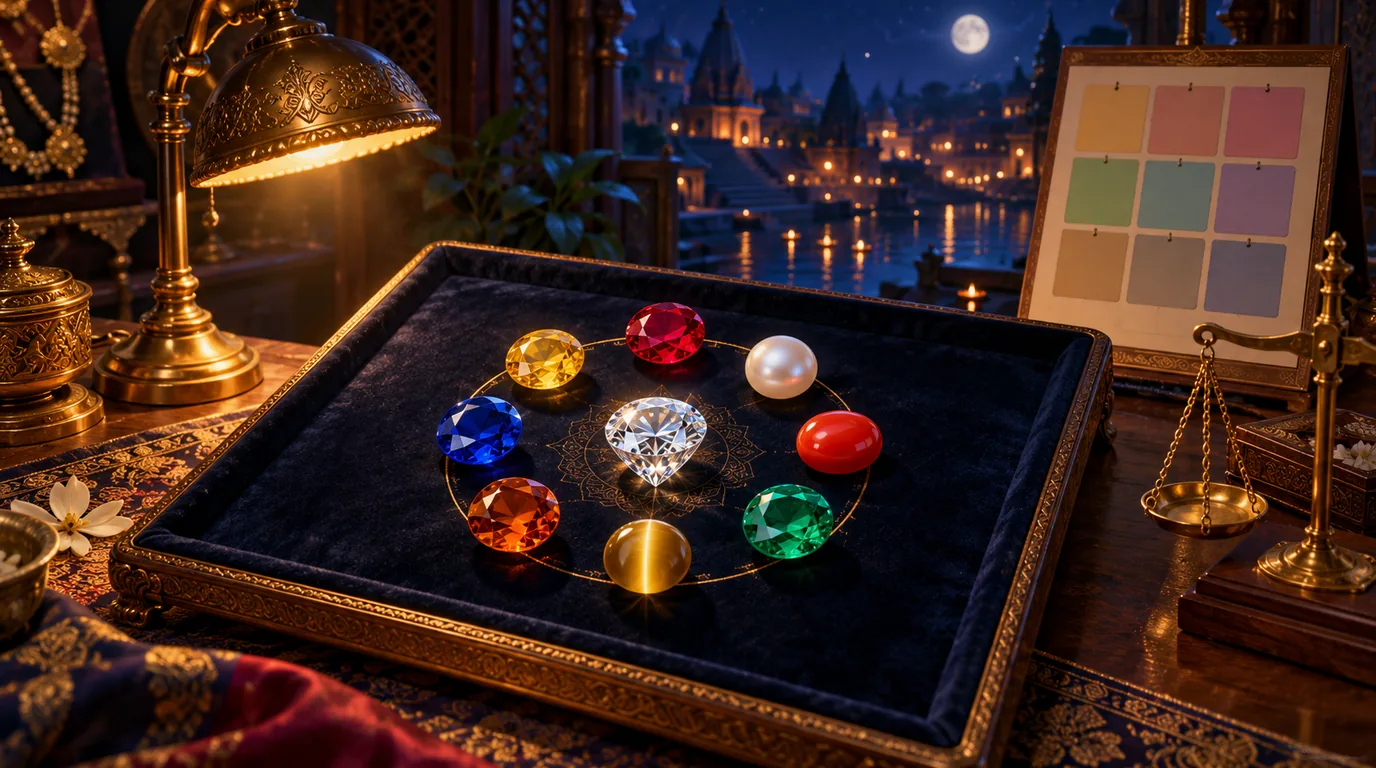
In Jyotish each of the nine grahas has a stone, and together they make the navaratna:
- Sun: Ruby (Manik)
- Moon: Pearl (Moti)
- Mars: Red Coral (Moonga)
- Mercury: Emerald (Panna)
- Jupiter: Yellow Sapphire (Pukhraj)
- Venus: Diamond or White Sapphire (Heera)
- Saturn: Blue Sapphire (Neelam)
- Rahu: Hessonite (Gomed)
- Ketu: Cat's Eye (Lehsunia)
The tradition's idea is that a stone strengthens its planet. That is exactly why it is not for everyone: strengthening a planet that works against your chart is said to do harm, not good.
What "rashi ratna" usually means
"Rashi ratna" usually means the stone of the planet that rules your rashi. Most sites use the Moon sign; some use the ascendant. This is the table they are built on:
| Rashi | Ruling planet | Traditional stone |
|---|---|---|
| Mesh (Aries) | Mars | Red Coral (Moonga) |
| Vrishabh (Taurus) | Venus | Diamond / White Sapphire (Heera) |
| Mithun (Gemini) | Mercury | Emerald (Panna) |
| Kark (Cancer) | Moon | Pearl (Moti) |
| Sinh (Leo) | Sun | Ruby (Manik) |
| Kanya (Virgo) | Mercury | Emerald (Panna) |
| Tula (Libra) | Venus | Diamond / White Sapphire (Heera) |
| Vrishchik (Scorpio) | Mars | Red Coral (Moonga) |
| Dhanu (Sagittarius) | Jupiter | Yellow Sapphire (Pukhraj) |
| Makar (Capricorn) | Saturn | Blue Sapphire (Neelam) |
| Kumbh (Aquarius) | Saturn | Blue Sapphire (Neelam) |
| Meen (Pisces) | Jupiter | Yellow Sapphire (Pukhraj) |
It is a useful map of which stone belongs to which sign. As a prescription it is too blunt: it gives every Makar and Kumbh person a blue sapphire, and every Mesh and Vrishchik person red coral, without asking whether that planet is good for their chart, where it sits, or how strong it already is.
How a chart-based gemstone is chosen
Our gem rule, the one behind the gem suggestions in the app, the free gemstone calculator and the Gemstone Report, starts from your ascendant (lagna), not from your month or your Moon sign:
- Candidates. Only the lords of the 1st, 5th and 9th houses, the three trines, are considered. These are the planets classical texts treat as reliably helpful for a chart.
- The lagna lord. The 1st lord is always a candidate, whatever other house it also rules.
- A trine lord that also rules the 6th or 8th. Its stone is still allowed, with a caution to have the whole chart checked first, because authorities disagree on such planets.
- Placement. A candidate sitting in the 6th, 8th or 12th house is ruled out, with one exception: the yogakaraka, a 5th or 9th lord that also rules the 4th, 7th or 10th, keeps its stone with a caution.
- Strength. A stone for a weak planet is graded as more useful; a stone for a planet that is already strong becomes optional.
- Blue sapphire. Neelam is never the headline recommendation. Where it qualifies, it is listed as optional and only after a trial of a few days.
Two things follow. Many people get no stone at all, or a stone that has nothing to do with their rashi. And the rule never names Gomed or Lehsunia, because Rahu and Ketu rule no house in this method.
Birthstone, rashi ratna and chart ratna compared
| Birthstone | Rashi ratna | Chart-based ratna | |
|---|---|---|---|
| Based on | Birth month | Lord of one sign | Ascendant, house lordship, placement and strength |
| Needs birth time | No | For the Moon sign, often yes | Yes |
| Can say "do not wear" | No | No | Yes |
| Purpose | Gift, jewellery, sentiment | Rough guide to a sign's planet | A traditional remedy for one chart |
Can I wear my birthstone anyway?
As jewellery, yes. The calendar list carries no instructions, so wear what you love. The one place to slow down is where a birthstone is also a Vedic ratna. Several are: ruby (July) is the Sun's stone, pearl (June) the Moon's, emerald (May) Mercury's and diamond (April) Venus's. And a September baby given a blue sapphire is, in Vedic terms, wearing neelam, the stone the tradition handles with most care.
If you follow Jyotish and plan to wear one of these as a remedy rather than as jewellery, check your chart first. If you are simply wearing a gift, the Vedic rules were never meant to stop you.
Before you buy any gemstone
- Ask for the reason. A good recommendation names the planet, the house it rules for your ascendant and why it passed. "Your rashi is Makar, so wear neelam" is not a reason.
- Check the stone, not the story. Buy from a seller who gives a certificate from a recognised gem laboratory, and expect treated or synthetic stones to be declared.
- Set a budget first. Bigger and costlier does not mean more effective. Never borrow to buy a stone.
- Keep expectations honest. No gemstone can guarantee a job, a marriage or a cure, and none replaces medical, legal or financial advice.
Our older guide Jyotish gemstones covers wearing practices, and the free Kundli shows your ascendant and house lords, the starting point for any chart-based choice.
Frequently asked questions about birthstones and rashi ratna
What is my birthstone by month?
January garnet, February amethyst, March aquamarine, April diamond, May emerald, June pearl, July ruby, August peridot, September sapphire, October opal, November topaz and December turquoise, with the other stones for each month in the table above.
Is a birthstone the same as a rashi ratna?
No. A birthstone comes from your birth month and has no rules about who should wear it. A rashi ratna is the stone of the planet ruling your sign, and Vedic astrology checks the chart before recommending it.
Which gemstone should I wear according to my rashi?
The popular table gives the stone of your rashi's ruling planet, but a chart-based rule looks at your ascendant's 1st, 5th and 9th lords, their placement and their strength. Many people are better off with no stone.
Can I wear a blue sapphire because September is my birth month?
As jewellery, the calendar list has no rules. As a Vedic remedy, neelam is the most cautioned stone and is only considered when Saturn suits your chart, and then after a trial.
Is there a free gemstone calculator?
Yes. The free gemstone calculator applies this rule to your date, time and place of birth and names each stone that passes, with the reason and any caution. The Gemstone Report shows the full working, including the strength index behind each grade.