Skip to content
Swarn Siddhi EN Get app Get app Open app
Open menu

Shukla paksha · Chaitra · amanta reckoning

When is Gudi Padwa 2027?

Gudi Padwa 2027

In 163 days

Wed, 7 Apr

Gudi Padwa 2027 is on Wednesday, 7 April. It is Pratipada of Shukla paksha in Chaitra.

2028: Monday, 27 March 2028

Also called Ugadi, Chaitra Navratri. Those are the same observance and the same date, so they share this page rather than competing with it from a second URL.

Ask Swarn

Is this muhurat good for my chart? Ask Swarn free

Computed for New Delhi

The date in New Delhi

Wednesday, 7 April 2027

Gudi Padwa is not a Gregorian date. It is Shukla paksha tithi 1 of Chaitra in the amanta reckoning, and the Gregorian day it lands on moves by up to a month between years because twelve lunations fall about eleven days short of a solar year.

Tithi
Pratipada, Shukla paksha
Lunar month
Chaitra (amanta)
Tithi begins
7 Apr, 5:21 AM
Tithi ends
8 Apr, 4:29 AM
Decided at
Sunrise
Sunrise in New Delhi
7 Apr, 6:04 AM

Sunrise in New Delhi falls at 6:04 AM on that day, and that is the instant the tithi has to be running at for the day to carry the observance. It is computed for this city rather than assumed, because it is what decides the date.

The two instants above are the astronomy and are not in dispute. The day is an interpretation of them: this observance is decided at sunrise, so it belongs to the day whose sunrise the tithi carries — not simply to the day the tithi begins.

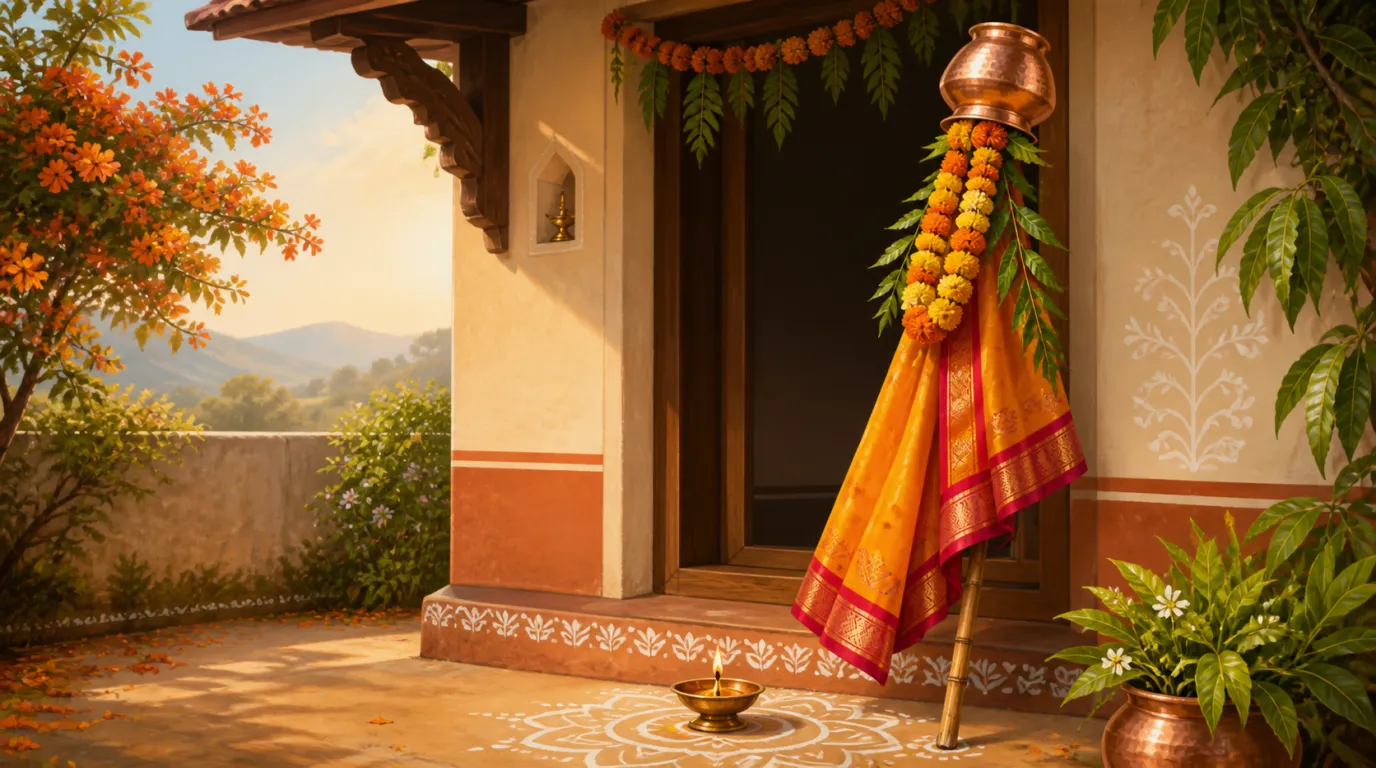
A traditional Maharashtrian gudi displayed at a decorated doorway for Gudi Padwa

Meaning and observance

What is Gudi Padwa?

Gudi Padwa is the Maharashtrian new-year festival observed on Chaitra Shukla Pratipada, the first tithi of the bright half of Chaitra.

  • A gudi—typically cloth, leaves, a garland and an upturned vessel raised on a staff—is displayed as a household sign of the new year and auspicious beginning.
  • Ugadi follows the same broad lunisolar new-year turn in parts of Karnataka, Andhra Pradesh and Telangana, with distinct regional names and customs.
  • Because Pratipada is a lunar tithi, the Gregorian date moves from year to year; the calculation above resolves it for the selected city.

All Gudi Padwa 2027 muhurat · New Delhi

Gudi Padwa muhurat

Gudi Padwa, Chaitra Shukla Pratipada, opens the Hindu lunar year in much of India: Maharashtra raises the gudi, a staff crowned with a pot and silk, at every door; Karnataka, Andhra Pradesh and Telangana keep it as Ugadi with the six-taste pachadi; and North India begins Chaitra Navratri and the new Vikram Samvat. In New Delhi it falls on Wednesday, 7 April 2027; the gudi is raised in the morning after sunrise (6:04 AM), and Pratipada runs 5:21 AM to 4:29 AM (8 Apr).

All Gudi Padwa 2027 muhurat in New Delhi
MuhuratTime in New DelhiWhat it is for
Sunrise (raising the gudi)6:04 AMThe upper edge of the Sun on the horizon, with refraction.

The gudi is raised in the morning, after the oil bath, soon after sunrise, so that it greets the first sun of the new year; it stays up through the day.

Abhijit Muhurat (an alternative for the kalash)None on a Wednesday: that muhurta is the day's Dur Muhurat.

The midday muhurta. Families who cannot set up the Chaitra Navratri kalash in the morning use it, if Pratipada still runs then; there is no Abhijit on a Wednesday, by convention.

Auspicious choghadiya (day)
  • Labh 6:04 AM to 7:39 AM
  • Amrit 7:39 AM to 9:14 AM
  • Shubh 10:48 AM to 12:23 PM
  • Chal 3:33 PM to 5:07 PM
  • Labh 5:07 PM to 6:42 PM
The day's Amrit, Shubh, Labh and Chal choghadiyas.

Many families begin new ventures, buy gold or a vehicle, or perform a griha pravesh on the new year's day, choosing one of its good choghadiyas.

Sunset (taking the gudi down)6:42 PMThe upper edge of the Sun leaving the horizon.

The gudi is taken down before sunset, after a short prayer; the sugar garland and the neem leaves are shared as prasad.

Auspicious windows that day

Auspicious windows that day
WindowTime in New DelhiWhat it is
Amrit Kaal4:01 PM to 5:37 PMMost Auspicious
Brahma Muhurat4:33 AM to 5:19 AMAuspicious

Windows usually worked around

These are the spans classical muhurta sets aside for beginnings. They are descriptions of a convention, not warnings: the observance is kept on its day regardless, and nothing here needs to be bought, corrected or remedied.

Windows usually worked around
WindowTime in New Delhi
Rahu Kaal12:23 PM to 1:58 PM
Yamaganda Kaal7:39 AM to 9:14 AM
Durmuhurta First11:58 AM to 12:48 PM
Varjyam6:24 AM to 8:00 AM

Every time above is computed for New Delhi around Wednesday, 7 April 2027, from the sunrise, sunset and the positions of the Sun and Moon for this city. The Vedic day runs sunrise to sunrise, so a window whose clock time falls after midnight still belongs to the evening before; a time on another date carries that date.

Puja vidhi · step by step at home

Gudi Padwa puja vidhi

  1. Oil bath at dawn

    Rise early, massage the body with oil and bathe; in many homes a few neem leaves are added to the water. Wear new or clean clothes.

  2. Clean and decorate the door

    Clean the house, draw a rangoli at the entrance and tie a toran of mango leaves and marigolds over the main door.

  3. Make the gudi

    Tie a bright silk cloth or saree (yellow, green or red) to the top of a long bamboo staff, with a sprig of neem leaves, a few mango leaves, a garland of flowers and a garland of sugar crystals (gathi). Place an upturned copper, brass or silver pot on the top, and draw a swastika on it with kumkum.

  4. Raise and worship the gudi

    Soon after sunrise, raise the gudi on the right side of the main door, at a window or on the terrace, standing on a small rangoli or a wooden base so that it can be seen from the street. Worship it with haldi, kumkum, rice, flowers, incense and a lamp, and offer a sweet; it stands for the Brahmadhwaja, Brahma's flag of creation.

  5. Neem and jaggery first

    Before breakfast, eat a little of the new year's first food: neem leaves or flowers with jaggery (and tamarind, in Maharashtra), or the Ugadi pachadi of six tastes; it is a reminder that the year will bring the bitter with the sweet.

  6. Worship and hear the panchang

    Worship the new year's panchang with haldi-kumkum, then read or hear its forecast for the year, as Ugadi's panchanga shravanam does at temples in the evening.

  7. Chaitra Navratri: the kalash

    If you keep Chaitra Navratri, set up the kalash in the morning while Pratipada runs: barley sown in a clay pot of soil, a water-filled kalash with mango leaves and a coconut wrapped in red cloth on top, and a lamp lit for the nine days. Worship Shailputri, the first form of Durga.

  8. Prayer for the year

    With folded hands, pray for health and well-being in the new year. Families who know it say the Brahmadhwaja verse at the gudi.

  9. Festive meal and visits

    Cook puran poli or shrikhand-puri in Maharashtra, obbattu or bobbatlu with mango rice in the South, and visit elders and the temple; in Mumbai, Thane and Pune join the shobha yatras.

  10. Take the gudi down

    Before sunset, offer a short prayer, take the gudi down and share the sugar garland as prasad.

Samagri · what to keep ready

Gudi Padwa puja samagri list

  • A long bamboo staff For the gudi; cleaned and, if you like, wrapped with a cloth strip.
  • A bright silk cloth or saree Yellow, green or red, tied at the top of the staff.
  • An upturned copper, brass or silver pot The kalash that crowns the gudi.
  • Neem twigs and mango leaves Tied to the gudi; neem also for the first food of the year.
  • A flower garland and a sugar crystal garland (gathi) For the gudi; the sugar garland is shared as prasad.
  • Haldi, kumkum and akshat For the swastika on the pot and the puja.
  • Flowers, incense and a ghee lamp For the worship of the gudi.
  • Rangoli colours and a toran For the doorway and the base of the gudi.
  • Neem leaves or flowers, jaggery and tamarind For the bitter-sweet first food of the year.
  • For the Ugadi pachadi Neem flowers, new jaggery, tamarind, raw mango, a pinch of salt and green chilli or pepper: the six tastes.
  • The new panchang Worshipped and read for the year's forecast.
  • For the Navratri kalash A clay pot with clean soil and barley, a kalash of water, five mango leaves, a coconut in red cloth, mauli, a red chunari and a lamp for the nine days.
  • Sweets for naivedya Puran poli, shrikhand or any sweet made at home.

Mantras · in Devanagari, with meaning

Gudi Padwa mantras and aarti

Brahmadhwaja verse (for the gudi)

ब्रह्मध्वज नमस्तेऽस्तु सर्वाभीष्टफलप्रद ।
प्राप्तेऽस्मिन्वत्सरे नित्यं मद्गृहे मङ्गलं कुरु ॥

Brahmadhvaja namaste'stu sarvabhishta-phalaprada
Prapte'smin vatsare nityam mad-grihe mangalam kuru

Meaning: Salutation to you, flag of Brahma, giver of every wished-for fruit; in this year that has come, bring auspiciousness to my home always.

When and how: Said once, with folded hands, after worshipping the raised gudi; a verse of the Maharashtrian household tradition, printed in Marathi puja books, whose older source is not known.

Shailputri dhyana (Navratri day one)

वन्दे वाञ्छितलाभाय चन्द्रार्धकृतशेखराम् ।
वृषारूढां शूलधरां शैलपुत्रीं यशस्विनीम् ॥

Vande vanchhita-labhaya chandrardha-krita-shekharam
Vrisharudham shuladharam Shailaputrim yashasvinim

Meaning: For the attainment of what is desired, I bow to the glorious Shailputri, daughter of the mountain, who wears the crescent moon on her head, rides the bull and holds the trident.

When and how: The meditation verse of the first day of Navratri, said 1, 3 or 11 times after setting up the kalash.

Sarva Mangala Mangalye

सर्वमङ्गलमाङ्गल्ये शिवे सर्वार्थसाधिके ।
शरण्ये त्र्यम्बके गौरि नारायणि नमोऽस्तु ते ॥

Sarva-mangala-mangalye shive sarvartha-sadhike
Sharanye tryambake Gauri Narayani namo'stu te

Meaning: O auspiciousness of all that is auspicious, O gracious one who accomplishes every aim, O refuge, three-eyed Gauri, Narayani: salutation to you. From the Devi Mahatmya (Durga Saptashati), chapter eleven.

When and how: Recited at the Navratri puja each day, once or three times, and at the aarti.

Ya Devi Sarvabhuteshu

या देवी सर्वभूतेषु शक्तिरूपेण संस्थिता ।
नमस्तस्यै नमस्तस्यै नमस्तस्यै नमो नमः ॥

Ya devi sarvabhuteshu shaktirupena samsthita
Namastasyai namastasyai namastasyai namo namah

Meaning: To the goddess who dwells in all beings in the form of power: salutation to her, salutation to her, salutation to her, again and again. From the hymn of the gods in the Devi Mahatmya, chapter five.

When and how: Recited through the nine days of Navratri, especially when lighting the lamp.

Aarti Durga Aarti: Jai Ambe Gauri the full text

जय अम्बे गौरी, मैया जय श्यामा गौरी।
तुमको निशदिन ध्यावत, हरि ब्रह्मा शिवरी॥
ॐ जय अम्बे गौरी॥

मांग सिंदूर विराजत, टीको मृगमद को।
उज्ज्वल से दोउ नैना, चंद्रवदन नीको॥
ॐ जय अम्बे गौरी॥

कनक समान कलेवर, रक्ताम्बर राजै।
रक्तपुष्प गल माला, कंठन पर साजै॥
ॐ जय अम्बे गौरी॥

केहरि वाहन राजत, खड्ग खप्पर धारी।
सुर-नर-मुनिजन सेवत, तिनके दुखहारी॥
ॐ जय अम्बे गौरी॥

कानन कुण्डल शोभित, नासाग्रे मोती।
कोटिक चंद्र दिवाकर, सम राजत ज्योती॥
ॐ जय अम्बे गौरी॥

शुंभ-निशुंभ बिदारे, महिषासुर घाती।
धूम्र विलोचन नैना, निशदिन मदमाती॥
ॐ जय अम्बे गौरी॥

चण्ड-मुण्ड संहारे, शोणित बीज हरे।
मधु-कैटभ दोउ मारे, सुर भयहीन करे॥
ॐ जय अम्बे गौरी॥

ब्रह्माणी, रुद्राणी, तुम कमला रानी।
आगम निगम बखानी, तुम शिव पटरानी॥
ॐ जय अम्बे गौरी॥

चौंसठ योगिनी मंगल गावत, नृत्य करत भैरों।
बाजत ताल मृदंगा, अरु बाजत डमरू॥
ॐ जय अम्बे गौरी॥

तुम ही जग की माता, तुम ही हो भरता।
भक्तन की दुख हरता, सुख संपति करता॥
ॐ जय अम्बे गौरी॥

भुजा चार अति शोभित, वर मुद्रा धारी।
मनवांछित फल पावत, सेवत नर नारी॥
ॐ जय अम्बे गौरी॥

कंचन थाल विराजत, अगर कपूर बाती।
श्रीमालकेतु में राजत, कोटि रतन ज्योती॥
ॐ जय अम्बे गौरी॥

श्री अंबेजी की आरति, जो कोइ नर गावे।
कहत शिवानंद स्वामी, सुख-संपति पावे॥
ॐ जय अम्बे गौरी॥

जय अम्बे गौरी, मैया जय श्यामा गौरी।

Jai Ambe Gauri, maiya jai Shyama Gauri.
Tumko nishdin dhyavat, Hari Brahma Shivri.
Om jai Ambe Gauri.

Maang sindoor virajat, tiko mrigmad ko.
Ujjwal se dou naina, chandravadan neeko.
Om jai Ambe Gauri.

Kanak saman kalevar, raktambar rajai.
Raktapushp gal mala, kanthan par sajai.
Om jai Ambe Gauri.

Kehari vahan rajat, khadag khappar dhari.
Sur-nar-munijan sevat, tinke dukhhari.
Om jai Ambe Gauri.

Kanan kundal shobhit, nasagre moti.
Kotik chandra divakar, sam rajat jyoti.
Om jai Ambe Gauri.

Shumbh-Nishumbh bidare, Mahishasur ghati.
Dhoomra vilochan naina, nishdin madmati.
Om jai Ambe Gauri.

Chand-Mund sanhare, Shonit Beej hare.
Madhu-Kaitabh dou mare, sur bhayheen kare.
Om jai Ambe Gauri.

Brahmani, Rudrani, tum Kamala rani.
Agam nigam bakhani, tum Shiv patrani.
Om jai Ambe Gauri.

Chaunsath yogini mangal gavat, nritya karat Bhairon.
Bajat taal mridanga, aru bajat damru.
Om jai Ambe Gauri.

Tum hi jag ki mata, tum hi ho bharta.
Bhaktan ki dukh harta, sukh sampati karta.
Om jai Ambe Gauri.

Bhuja char ati shobhit, var mudra dhari.
Manvanchhit phal pavat, sevat nar nari.
Om jai Ambe Gauri.

Kanchan thaal virajat, agar kapoor bati.
Shri Malketu mein rajat, koti ratan jyoti.
Om jai Ambe Gauri.

Shri Ambe ji ki aarti, jo koi nar gave.
Kahat Shivanand Swami, sukh-sampati pave.
Om jai Ambe Gauri.

Jai Ambe Gauri, maiya jai Shyama Gauri.

Text as it is commonly sung. The Gita Press Aarti Sangrah prints 'chaunsath yogini gavat' without 'mangal', 'nritya karat Bhairun' for 'Bhairon' and 'au bajat damru' for 'aru bajat damru'; the rest is the same. Printed text

Katha · the story and its meaning

Gudi Padwa katha and significance

The katha

Tradition holds that Brahma began the creation of the world on Chaitra Shukla Pratipada, at sunrise, which is why the lunar new year begins on this day; a verse quoted from the Brahma Purana in the dharmashastra digests says so. The gudi is raised as Brahma's flag, the Brahmadhwaja, and the day is also called Yugadi or Ugadi, the beginning of an age.

Maharashtra adds its own memories: the gudi is said to recall the flags raised to welcome Rama home to Ayodhya after his victory, and the victory of King Shalivahana, from whom the Shalivahana Shaka era, still counted from this day, takes its name. North India counts the new Vikram Samvat, named after King Vikramaditya, from the same Pratipada.

The same morning opens Chaitra Navratri. Its first day belongs to Shailputri, the daughter of the mountain king Himavan, the goddess who had been Sati in her earlier birth and was born again as Parvati; the nine days that follow end with Rama's birth on Navami.

Why it is kept

Gudi Padwa is a beginning: of the lunar year, of spring's harvest season, of Chaitra Navratri. The gudi, a staff crowned with an upturned pot and bright silk, stands for victory and well-being, and the first bitter-sweet taste of neem and jaggery says the year will bring both. Many families buy gold, a vehicle or a house, or start a business, on this day, which tradition counts among the most auspicious of the year.

The same day has many names: Gudi Padwa in Maharashtra and Sanvsar Padvo in Goa, Ugadi in Karnataka, Andhra Pradesh and Telangana, Navreh for Kashmiri Pandits, Sajibu Cheiraoba in Manipur and Hindu Nav Varsh in the North; Sindhis keep Cheti Chand at the first sighting of the new moon, on the same day or the next. Communities that follow the solar calendar keep their new year at Mesha Sankranti instead, which coastal Karnataka calls Souramana Ugadi.

Upay · traditional practice

Gudi Padwa upay: traditional remedies

Neem and jaggery first

Eat a little neem with jaggery before anything else on the new year's morning. Tradition, and Ayurveda's seasonal advice, keeps it as a cleansing start to the warm months.

Raise the gudi facing the sun

Raise the gudi in the morning where it catches the sun and can be seen; it is believed to welcome good fortune into the house for the year.

Begin something new

Begin a new venture, a course of study or a good habit on this day. Tradition counts the new year's day itself as auspicious for beginnings.

Hear the year's panchang

Worship the new panchang and listen to its reading of the year. Families keep it to start the year aware of its festivals and seasons.

Light the Navratri lamp

If you keep Chaitra Navratri, light the lamp at the kalash and keep it burning through the nine days, safely; it is believed to keep the goddess's presence in the house.

Give to begin the year

Give food, water or a fan to someone in need as the warm season begins; tradition holds that a year begun with giving goes well.

The custom, in short

Gudi Padwa do's and don'ts

Do

  • Bathe early with oil and wear new or clean clothes.
  • Raise the gudi after sunrise, where it can be seen, and take it down before sunset.
  • Eat neem with jaggery, or the Ugadi pachadi, as the first food of the day.
  • Worship the new panchang and hear the year's reading.
  • Set up the Navratri kalash in the morning while Pratipada runs, if you keep the fast.
  • Visit elders and the temple and greet the new year together.

Don't

  • Do not raise the gudi on a broken or dirty staff, or let the cloth touch the ground.
  • Do not leave the gudi up after sunset.
  • Do not begin the new year with a quarrel or harsh words.
  • Do not set up the Navratri kalash after Pratipada has ended; use the Abhijit muhurat while it still runs.
  • Do not let the Navratri lamp burn unattended near curtains.

Across India

Gudi Padwa customs and food

By region

Maharashtra (Gudi Padwa)
A gudi at every door, rangoli, shobha yatras in Girgaon, Thane, Dombivli and Pune, neem and jaggery, and puran poli or shrikhand-puri.
Goa (Sanvsar Padvo)
The Konkani new year: a gudi at the door, neem and jaggery, and the new panchang worshipped and read.
Karnataka (Ugadi)
Bevu-bella, neem and jaggery, shared as a reminder that life brings both; obbattu or holige for the meal, and the panchanga shravana in the evening.
Andhra Pradesh and Telangana (Ugadi)
Ugadi pachadi of six tastes, bobbatlu, mango pulihora, the panchanga shravanam of the year's forecast, and kavi sammelanams, gatherings of poets.
North India (Hindu Nav Varsh)
The new Vikram Samvat begins, Chaitra Navratri's kalash is set up, barley is sown and homes and temples are decorated.
Kashmir (Navreh)
Kashmiri Pandits see a thali of rice, walnuts, a new panchang, flowers, curd and a mirror first thing on the new year's morning.
Manipur (Sajibu Cheiraoba)
The Meitei new year, with a special meal offered at the gate and a climb up a hill for a good year.
Sindhi community (Cheti Chand)
Close to the same day, at the first sighting of the new crescent moon of Chet, Sindhis celebrate Cheti Chand: the birth of Jhulelal and the Sindhi new year.

Bhog, prasad and fasting food

  • Ugadi pachadi Neem flowers, new jaggery, tamarind, raw mango, salt and chilli: bitter, sweet, sour, astringent, salty and hot, the six tastes of the year.
  • Neem and jaggery (bevu-bella, kadulimb) The bitter-sweet first food of the new year in Maharashtra and Karnataka.
  • Puran poli Flatbread filled with chana dal and jaggery, Maharashtra's festival sweet.
  • Shrikhand-puri Sweetened hung curd with saffron and cardamom, eaten with puris.
  • Obbattu, holige or bobbatlu The South's sweet flatbreads for Ugadi.
  • Mango pulihora Raw-mango rice, the season's first mango in the meal.
  • Phalahar for Navratri Fruit, sabudana and kuttu for those who begin the nine-day fast.

Gudi Padwa across five years

Two years back, this year, and two ahead. Past years are kept rather than dropped so you can check the engine against a calendar you already have.

Gudi Padwa across five years
YearDateStatus
2024Tuesday, 9 April 2024past
2025Sunday, 30 March 2025past
2026This yearThursday, 19 March 2026past
2027Wednesday, 7 April 2027upcoming
2028Monday, 27 March 2028upcoming

Every row is computed for New Delhi from the same ephemeris, not looked up. Sunrise decides which day a tithi names, and sunrise differs across India by more than an hour, so a date computed for Delhi can be a day out elsewhere.

Why calendars disagree about this date

There is no single authority that settles a Hindu festival date, and the divergence is genuine rather than sloppy. Three causes account for almost all of it.

  1. A tithi rarely starts at sunrise. One that is running at the deciding moment on two days — or on none — is claimed by both days under different rules.
  2. Month reckoning. North India runs purnimanta, the south and west amanta. The same dark fortnight carries different month names in the two, so an observance defined as "krishna X of month Y" can land a full lunation apart.
  3. Which moment decides. Most vratas belong to the day whose sunrise carries the tithi, but not all: this one is decided at sunrise. Almanacs that apply the sunrise rule to everything move several festivals by a day.

So this page shows its working. If your pandit or your family almanac gives a different day, the instants above will usually show you exactly why — and that is more useful than a date asserted without one.

Common questions

When is Gudi Padwa?

In New Delhi, Gudi Padwa is on Wednesday, 7 April 2027. It is Chaitra Shukla Pratipada, the first day of the bright half of Chaitra, and Pratipada runs 5:21 AM to 4:29 AM (8 Apr). The same day is Ugadi in the South, the first day of Chaitra Navratri and the start of the new Vikram Samvat.

Why does another calendar give a different Gudi Padwa date?

Three honest reasons. The tithi can be running at the deciding moment on two days or on none. North India reckons the month purnimanta and the south and west amanta, which names the same krishna fortnight differently. And almanacs differ on which moment of the day decides an observance. The instants above are the astronomy; the day is an interpretation of them.

What is the Gudi Padwa muhurat for raising the gudi?

There is no separate classical muhurat for the gudi: it is raised in the morning, after the oil bath and soon after sunrise (6:04 AM), and taken down before sunset (6:42 PM). Families who like an auspicious span raise it in one of the morning's good choghadiyas, listed here with the rest of the day's (Labh: 6:04 AM to 7:39 AM; Amrit: 7:39 AM to 9:14 AM; Shubh: 10:48 AM to 12:23 PM; Chal: 3:33 PM to 5:07 PM; Labh: 5:07 PM to 6:42 PM).

How is the gudi made and raised?

Tie a bright silk cloth to the top of a long bamboo staff with neem twigs, mango leaves, a flower garland and a sugar garland, and crown it with an upturned copper or brass pot marked with a kumkum swastika. Raise it after sunrise beside the main door or on the terrace, worship it with haldi, kumkum, flowers and a lamp, and take it down before sunset.

What does Gudi Padwa mean?

A gudi is the flag-like staff raised at the door, and padwa is the Marathi word for Pratipada, the first day of the lunar fortnight. So Gudi Padwa is the Pratipada of the gudi: the first day of Chaitra, the lunar new year, when the gudi is raised as a sign of victory and welcome.

Why is Gudi Padwa celebrated?

It is the lunar new year: tradition holds that Brahma began creation on Chaitra Shukla Pratipada, and the gudi is raised as his flag. Maharashtra also remembers Rama's return to Ayodhya and King Shalivahana's victory, whose Shaka era begins on this day. It opens the year's harvest season and Chaitra Navratri.

Are Gudi Padwa and Ugadi the same?

Yes, they are the same new year's day, Chaitra Shukla Pratipada, under different names and customs: Maharashtra raises the gudi and eats neem with jaggery; Karnataka, Andhra Pradesh and Telangana call it Ugadi, eat the six-taste pachadi and hear the panchang read. North India keeps it as Hindu Nav Varsh and the start of Chaitra Navratri.

When is Ugadi?

Ugadi falls on the same day as Gudi Padwa, Chaitra Shukla Pratipada: Wednesday, 7 April 2027 in New Delhi. In Karnataka, Andhra Pradesh and Telangana the day begins with an oil bath and mango-leaf torans at the door, the Ugadi pachadi is eaten first, and the year's panchang is heard in the evening. Coastal Karnataka's Souramana Ugadi, the solar new year, is kept separately, at Mesha Sankranti.

What is Ugadi pachadi, and what are its six tastes?

Ugadi pachadi is the first food of the Telugu and Kannada new year, a mix of neem flowers (bitter), new jaggery (sweet), tamarind (sour), raw mango (astringent and tangy), a pinch of salt and green chilli or pepper (hot). Eaten together, the six tastes say the year will bring every kind of experience, and all are to be accepted.

When does Chaitra Navratri begin, and when is the kalash set up?

Chaitra Navratri begins on this day, Pratipada, Wednesday, 7 April 2027 in New Delhi. The kalash, or ghatasthapana, is set up in the morning while Pratipada runs (5:21 AM to 4:29 AM (8 Apr)), traditionally in the first part of the day; if that is not possible, the Abhijit muhurat (not observed on a Wednesday this year) is the usual alternative while Pratipada still lasts.

What are the colours of Chaitra Navratri?

Lists of a colour for each day of Navratri are a recent popular custom, and different sources give different lists, so this page does not present one as a rule. Traditionally red and yellow are worn for the goddess's worship; wear what is clean and bright.

What is Hindu Nav Varsh, and which Samvat begins?

Hindu Nav Varsh is the lunar new year of North India, beginning on Chaitra Shukla Pratipada, when the new year of the Vikram Samvat begins; in Maharashtra and the Deccan the Shalivahana Shaka year turns on the same day. The year numbers change every year, and calendars print them on this date.

What is the Telugu year name announced at Ugadi?

Telugu and Kannada calendars name each year from a cycle of sixty samvatsaras, beginning with Prabhava; at Ugadi, the panchanga shravanam announces the new year's name and its forecasts for rain, crops and each sign. The name changes every year and is printed in the Ugadi panchangam.

What is the difference between Chandramana and Souramana Ugadi?

Chandramana Ugadi, kept on Chaitra Shukla Pratipada, is the lunar new year followed in most of Karnataka, Andhra Pradesh and Telangana. Souramana Ugadi is the solar new year, kept when the Sun enters Mesha by communities of coastal Karnataka that follow the solar calendar; the same solar new year is Vishu in Kerala and Puthandu in Tamil Nadu.

What food is made on Gudi Padwa?

The day begins with neem and jaggery, or the Ugadi pachadi, and the festive meal is puran poli or shrikhand-puri in Maharashtra, obbattu or holige in Karnataka and bobbatlu with mango pulihora in Andhra Pradesh and Telangana. Those starting the Navratri fast eat fruit and phalahar.

Is Gudi Padwa a good day to buy gold, a vehicle or a house?

Tradition counts Gudi Padwa among the most auspicious days of the year: in Maharashtra it is one of the sade teen muhurat, the three and a half days held auspicious in themselves, with Akshaya Tritiya, Dussehra and, as the half, Diwali Padwa. Many families buy gold, a vehicle or a home, or start a business, on it, and some choose a good choghadiya of the day (Labh: 6:04 AM to 7:39 AM; Amrit: 7:39 AM to 9:14 AM; Shubh: 10:48 AM to 12:23 PM; Chal: 3:33 PM to 5:07 PM; Labh: 5:07 PM to 6:42 PM); the decision itself should rest on sound financial sense, not on the date.