What Vastu is
Vastu Shastra is a traditional Indian body of guidance on the siting, orientation and internal layout of buildings. Vastu means dwelling; shastra means a body of knowledge.
It organises a building around two things: the eight directions, each assigned a governing planet and element, and the five elements (pancha bhoota) — earth, water, fire, air and space. The stated aim is a building whose layout cooperates with the movement of light, air and heat rather than fighting it.
Worth separating two things immediately, because they get conflated. Vastu contains genuinely sensible building sense with a clear physical rationale, and it also contains prescriptions that are purely symbolic. Both are presented in the same voice by most sources. This guide will mark which is which.
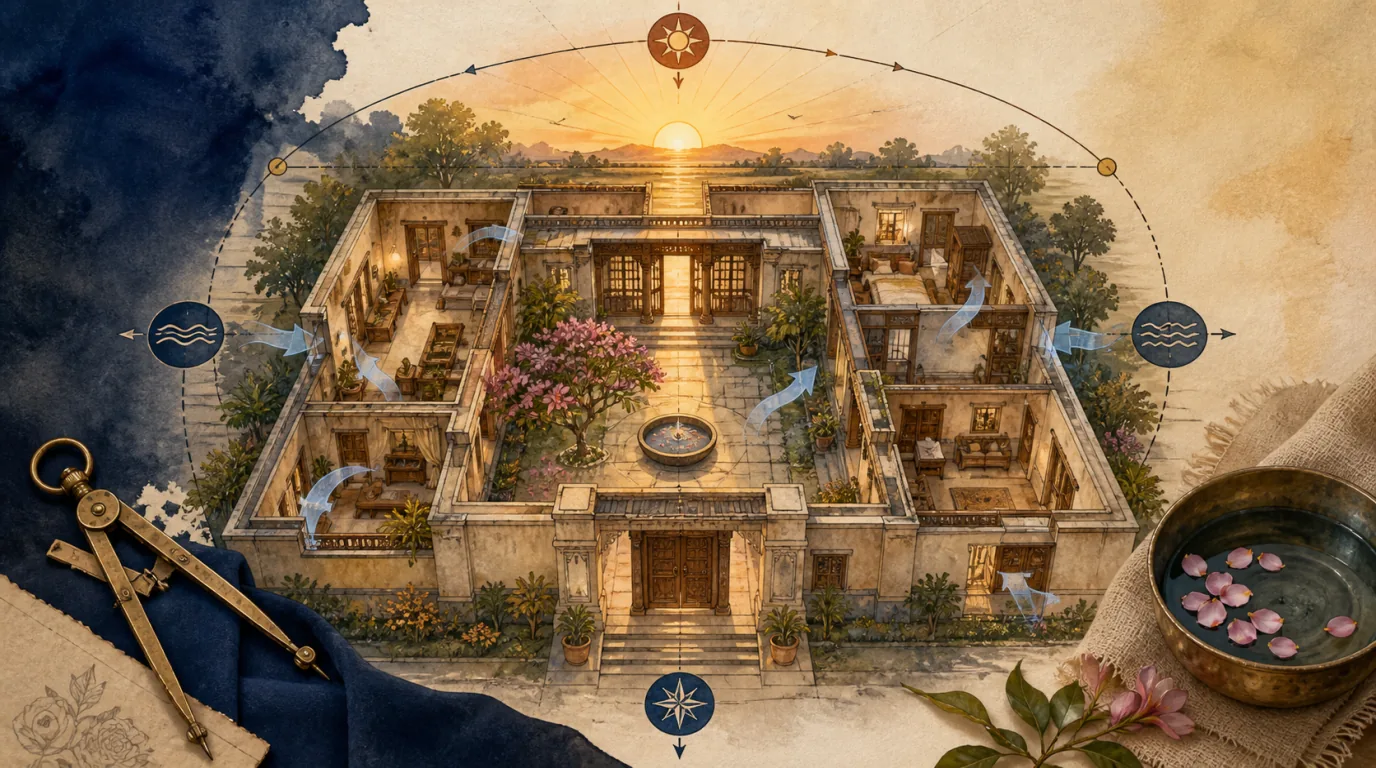
The eight directions
| Direction | Element / ruler | Traditionally used for |
|---|---|---|
| North-east (Ishanya) | Water · Jupiter | Prayer room, water source, open space. The most valued zone. |
| East | Air · Sun | Main entrance, windows, living areas |
| South-east (Agneya) | Fire · Venus | Kitchen, electrical equipment |
| South | Earth · Mars | Bedrooms, heavy storage |
| South-west (Nairutya) | Earth · Rahu | Master bedroom, heaviest structure. Kept solid and closed. |
| West | Water · Saturn | Dining, children's study |
| North-west (Vayavya) | Air · Moon | Guest room, storage, movement |
| North (Kubera) | Water · Mercury | Openings, treasury, cash |
The central zone, Brahmasthan, is traditionally kept open and unbuilt — no heavy structure, no staircase, no toilet. Of all Vastu rules this is the one practitioners treat as least negotiable.
The rules with a physical explanation
Several core prescriptions make straightforward sense once you remember the system was developed for the Indian subcontinent, in the northern hemisphere, largely without mechanical cooling.
- North-east kept open and light. In the northern hemisphere the north-east receives gentle early morning sun and no harsh afternoon heat. Putting living space and water there is sound climate design.
- South-west kept heavy and closed. The south-west takes the most punishing afternoon sun. Thick walls and minimal openings there is exactly how you keep a building cool.
- Kitchen in the south-east, cook facing east. Keeps cooking heat away from living areas and lets morning light in while the evening kitchen stays out of the hottest wall.
- Sleeping with the head to the south. Widely prescribed, and the traditional explanation is magnetic alignment. Honest position: no reliable evidence supports a health effect. There is no harm in it either.
- Brahmasthan open. A clear, unobstructed centre gives cross-ventilation and a light well. In a hot climate that is functional, not mystical.
This is the substantive core of Vastu: climate-responsive architecture encoded in directional language and carried forward for centuries. Read that way it is worth attention.
What does not have a physical explanation
Fair to be equally direct here. Rules about which direction a mirror faces, where a money safe opens toward, precise permitted degrees for a main door, and the placement of specific idols carry no physical mechanism. They are symbolic conventions.
They may still matter to you, and there is nothing wrong with following a tradition because it is yours. But they are a different category from ventilation, and should not be priced as though they change outcomes.
The commercial problem
Vastu correction is a large industry in India, and it has a structure worth recognising.
The pattern: a consultant surveys the property, identifies multiple defects, attributes existing difficulties — money, health, family friction — to them, and proposes remedies. Those may include pyramids, yantras, copper strips, colour changes, or in serious cases demolition and rebuilding.
Three things to hold on to. Structural changes are expensive and irreversible, so the burden of proof should be high before you break a wall. No controlled study supports the claim that layout affects wealth, health or relationships beyond the well-understood effects of light, air quality and noise. And a diagnosis that arrives with a product attached deserves the same scepticism you would apply in any other field.
If a consultant tells you your business is failing because of a south-west entrance, ask what evidence connects the two. A reputable practitioner will be candid that they are working within a tradition.
Practical, low-cost improvements
If you want to apply Vastu without renovating, these are the changes that are cheap, reversible, and often improve the space regardless of what you believe:
- Declutter the north-east and the centre. Clearing the brightest corner and the middle of a home improves both light and circulation.
- Move heavy furniture to the south and west. No cost, and it tends to leave lighter areas near windows.
- Keep the entrance clean, lit and unobstructed. Universally recommended, and genuinely affects how a home feels.
- Fix leaking taps, particularly in the north-east. Vastu treats this as serious; so does your water bill.
- Do not put a bed under a beam — the traditional rule matches a real sense of oppression that most people report.
- Improve light and ventilation anywhere you can. This is the measurable part.
Notice that every item on that list is defensible on ordinary grounds. That is deliberate — it is the overlap between the tradition and things that reliably help.
Vastu and astrology are separate systems
A common confusion worth clearing. Vastu is about place; jyotish is about time and the birth chart. They use overlapping vocabulary — the same nine grahas, the same directions — but they are distinct disciplines with distinct methods.
Some practitioners combine them, matching directional recommendations to a resident's chart. That is a modern synthesis rather than classical doctrine, and you should know which you are being offered.
Honest limits
Vastu texts disagree with each other, regional traditions differ substantially, and the rules were written for detached low-rise buildings in a specific climate. Applying them literally to a fourteenth-floor apartment with a fixed floor plan produces contradictions the tradition never anticipated.
The reasonable position: take the climate-responsive core seriously, treat the symbolic layer as a matter of personal meaning, and do not spend significant money on structural correction. If a home has poor light and air, fix that — the benefit is real and does not depend on which system you credit.
Related reading
For the directional and planetary vocabulary Vastu borrows, see the navagraha guide. For timing a housewarming or a move, the muhurta guide and today's panchang cover the traditional approach.
Guidance here is a framework for reflection and planning — not architectural, structural, medical, legal or financial advice. Consult a qualified engineer or architect before any structural change.
Frequently asked questions about Vastu Shastra
Do I need to rebuild my home to follow Vastu?
No. Start with low-cost changes that also improve daily life, such as clearer circulation, safer storage, light, ventilation and a calmer sleep space. Structural changes need qualified building advice.
Is every northeast kitchen a serious defect?
No. It is a mismatch with one traditional layout rule, not proof of harm. Fire safety, extraction, plumbing, hygiene and the real constraints of the home come first.
Can Vastu diagnose a health problem?
No. Vastu is not a medical diagnostic system. Symptoms need appropriate clinical care, while housing issues such as damp, heat, air quality and noise should be addressed with evidence-based guidance.
Now try it on your own numbers
This guide explains the method. Open the Vastu compass to run it — the page shows its working, so you can check every step against what you have just read rather than taking the result on trust.