What pitra dosha is said to be
Pitra dosha is a chart condition traditionally interpreted as an unresolved obligation to one's ancestors. Pitra (or pitru) means forefathers.
The traditional framing is that ancestral duties left undone — rites not performed, debts not settled, wrongs not made good — carry forward and manifest as recurring obstacles for descendants. It is one of the more emotionally loaded ideas in Indian astrology because it attaches present difficulty to family history.
Before the details, one structural point that shapes everything below: pitra dosha has no single agreed definition. Unlike manglik dosha, which is a precise placement rule, or kaal sarp, which is a binary geometric test, pitra dosha is identified by a loose family of indicators that vary substantially between practitioners. That vagueness is worth holding on to.
The commonly cited indicators
Most readings look for some combination of:
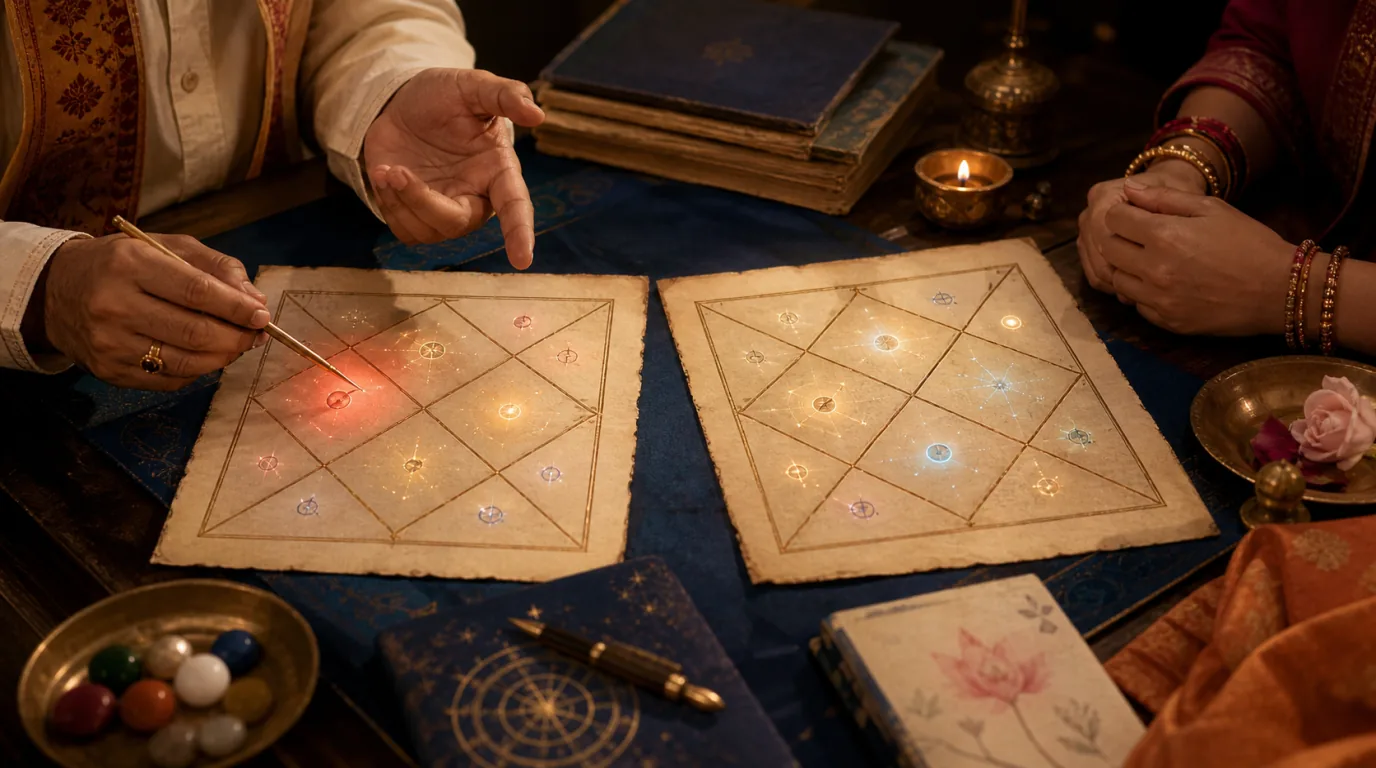
- Sun conjunct Rahu or Ketu — the most frequently cited signature. The Sun signifies father and paternal lineage; the nodes are read as eclipsing it.
- Affliction to the 9th house — the house of father, fortune and dharma — or to its ruler.
- Sun in the 9th with a malefic, or malefics occupying the 9th.
- Rahu or Ketu in the 9th.
- Jupiter afflicted, as the natural significator of ancestors and dharma.
- In some schools, a Moon–Rahu combination for the maternal line.
Notice how broad that list is. Several of these placements are common — Sun–Rahu conjunctions alone occur in a substantial fraction of charts, and something in the 9th is true of most people. Apply the full list generously and a large share of the population qualifies, which is a serious problem for a condition described as a specific ancestral debt.
What the tradition claims it causes
The themes attributed to it: repeated obstacles in matters that should be straightforward, difficulty with progeny, family discord across generations, patterns that appear to recur through a lineage, and delays in the affairs of the 9th house — fortune, education, paternal relationships.
The astrological logic is at least internally consistent. The Sun signifies father and forebears; Rahu and Ketu signify obscuration and unfinished business; the 9th house holds lineage and dharma. A combination of the three producing a lineage-themed reading follows from the system's own vocabulary.
What does not follow is the leap from "this configuration signifies ancestral themes" to "your grandfather's unperformed rites are causing your current problems." That is an additional metaphysical claim the chart geometry does not establish.
The traditional remedies
The prescribed remedies centre on shraddha — the rites for the departed — and are among the oldest continuous practices in Hindu tradition:
- Pitru Paksha observance. A fortnight in the lunar month of Bhadrapada set aside for ancestral rites, observed annually by many families regardless of any chart.
- Tarpan — water offerings to ancestors.
- Shraddha at Gaya, traditionally regarded as the most significant location for these rites.
- Feeding — brahmins, the poor, crows (traditionally associated with ancestors), and cows.
- Charity on Amavasya, particularly the new moon of Pitru Paksha.
Worth saying clearly: most of these are ordinary observances that a great many Indian families perform anyway, without reference to any dosha. Honouring the dead, feeding people, and gathering annually to remember forebears are practices with obvious social and psychological value. If a reading prompts you to reconnect with them, little is lost.
The fear economy
This is where honesty is owed, because pitra dosha is heavily monetised and its structure makes it especially effective at extracting money.
Consider how the claim works. It attributes present difficulty to something you cannot verify and did not do. It is unfalsifiable — no outcome can disprove it. It carries family guilt, which is a stronger motivator than personal fear. And it prescribes rituals that must be performed by someone else, for a fee, often at a distant pilgrimage site.
Add the definitional vagueness and you have a condition that can be found in almost any chart, cannot be disproved, and comes with a paid solution. That combination should raise your guard regardless of what you believe about astrology.
Specific warning signs: an unsolicited reading that opens with pitra dosha; a claim that a specific misfortune in your family is explained by it; urgency about performing rites by a particular date; and packages priced in tens of thousands. No classical text sets a price on shraddha.
The honest position
Three things can be true at once.
The chart indicators are real and identifiable — Sun–Rahu conjunctions exist and can be checked. The traditional interpretation is a coherent part of a system that reads lineage through the Sun and the 9th house. And there is no evidence that ancestral rites affect a descendant's circumstances, no agreed definition of the condition, and a documented pattern of the concept being used commercially.
If your family already observes Pitru Paksha, continue — it is a meaningful tradition. If a reading has caused you real distress about a family debt you cannot name, it is reasonable to conclude that a condition this loosely defined cannot support that weight.
And where difficulties are genuinely recurring across a family, the more useful frames are usually the ordinary ones: inherited circumstances, learned patterns, health conditions that run in families, and financial position. Those are addressable in ways a ritual is not.
Check the placements yourself
The free birth chart calculator shows your Sun, Rahu, Ketu and 9th house directly, so you can see which of the indicators above actually apply rather than taking a verdict on trust.
For the underlying vocabulary see the navagraha guide, the twelve houses guide and the aspects guide.
Astrology here is a framework for reflection and planning — not medical, legal or financial advice. No chart configuration determines your outcome.
Frequently asked questions about Pitra Dosha
Is there one agreed definition of Pitra Dosha?
No. Different practitioners use Sun-node combinations, 9th-house affliction or wider ancestral indicators. Ask for the exact placements behind the label before accepting it.
Does Pitra Dosha mean an ancestor is punishing me?
That is a belief claim, not something a chart can establish. A non-blaming reading can use the symbolism to reflect on family patterns without accusing the living or the dead.
Do I need an expensive ritual?
No. If remembrance, charity or a family observance has personal meaning, it can be done within your means. Fear, urgency and a guaranteed cure are reasons to step away.
Now try it on your own numbers
This guide explains the method. Open the Pitra Dosh calculator to run it — the page shows its working, so you can check every step against what you have just read rather than taking the result on trust.