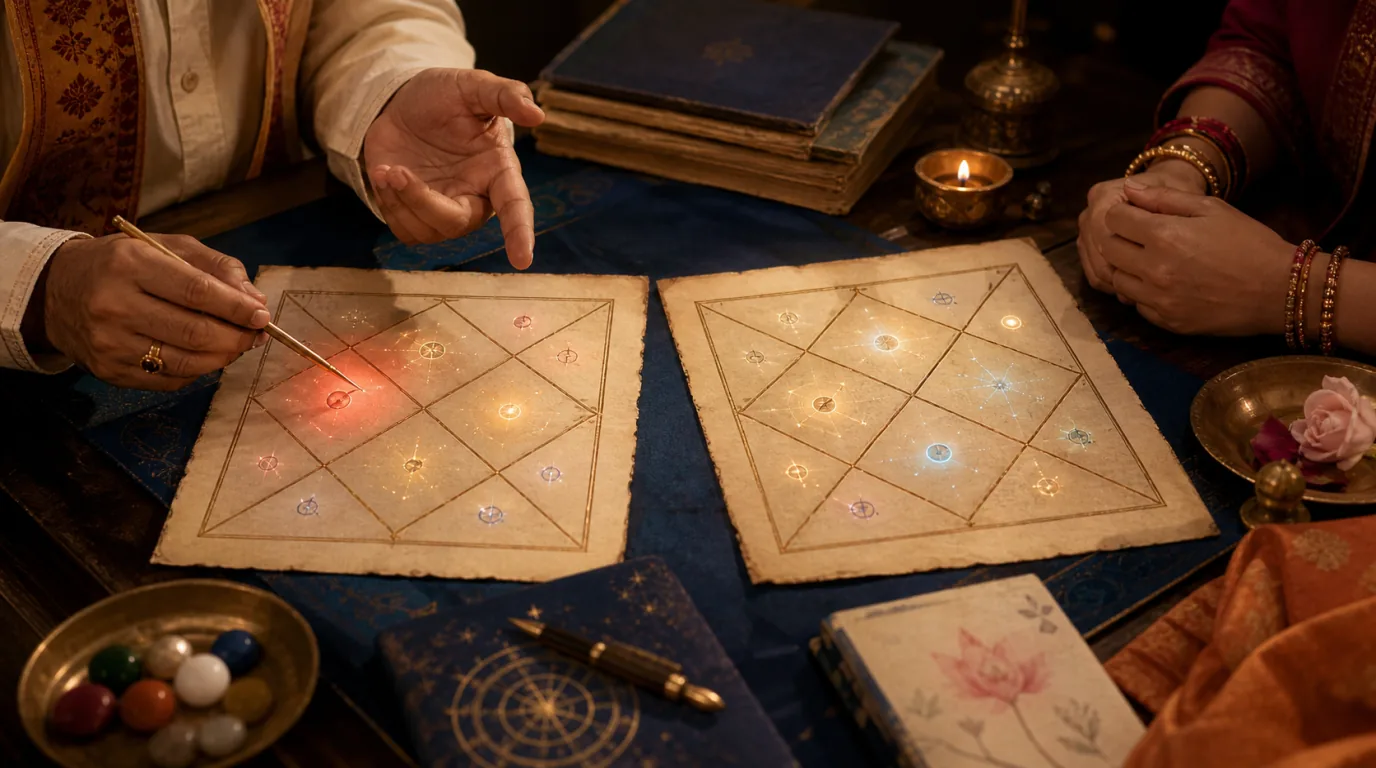
What kaal sarp dosha is
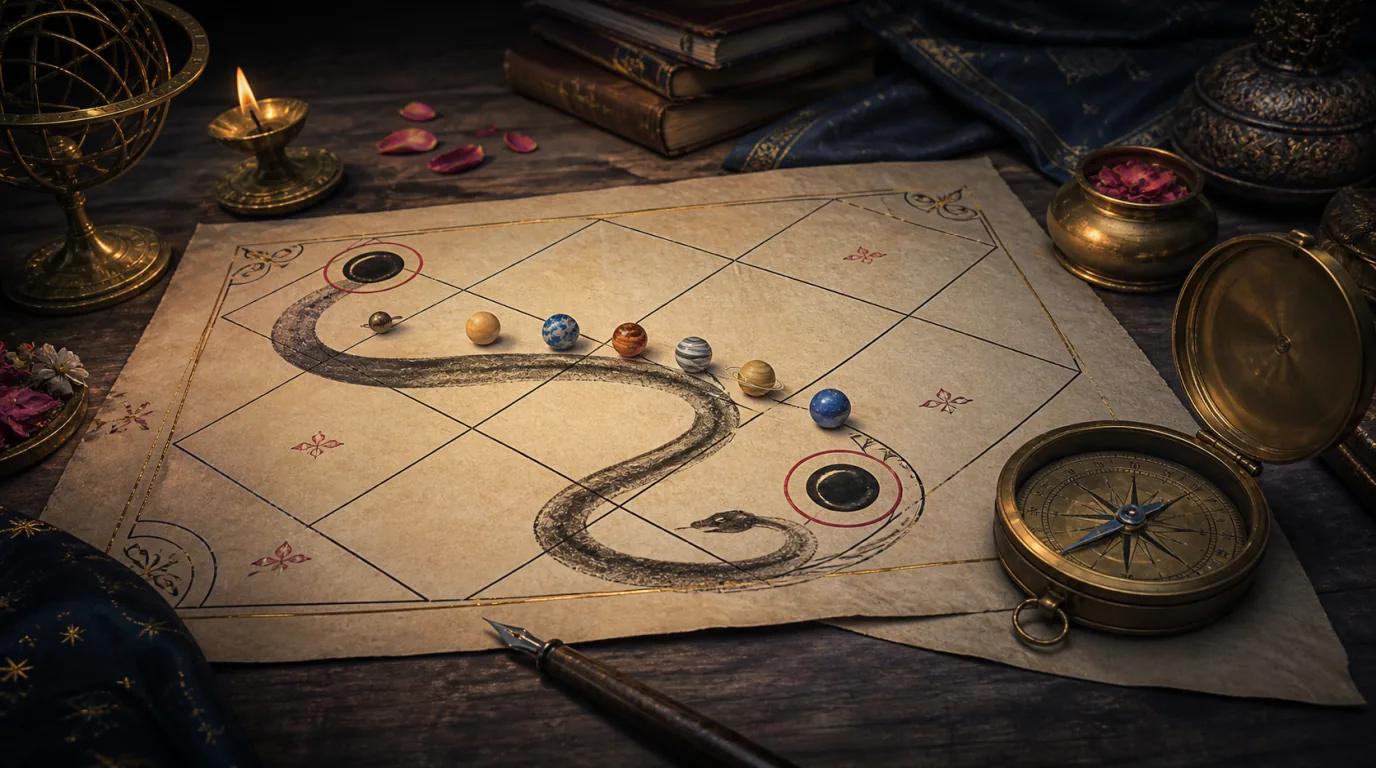
Kaal sarp dosha (or kaal sarp yoga) is the condition where all seven classical grahas — Sun, Moon, Mars, Mercury, Jupiter, Venus and Saturn — fall on one side of the Rahu–Ketu axis.
Rahu and Ketu are the lunar nodes, always exactly 180° apart, so they cut the chart into two halves. If every other graha is hemmed into one half, the chart is said to be caught in the serpent's coil — Rahu the head, Ketu the tail, the rest of the chart swallowed between them.
The condition is strictly binary. One graha outside the axis and the dosha does not form. Not "partially", not "mildly" — the classical definition either holds or it does not.
How it is calculated
Take the longitudes of Rahu and Ketu, and check whether all seven remaining grahas fall in the arc running from Rahu to Ketu in zodiacal order.
Direction matters and is the most common source of disagreement. The dosha is conventionally counted from Rahu forward to Ketu. If all seven sit in the other arc — Ketu forward to Rahu — many practitioners call it a reverse or anulom arrangement and read it very differently, or not as a dosha at all.
The other live dispute is whether the nodes' own degrees count as boundaries a graha may sit exactly on. Software handles this inconsistently, which is why a chart with a graha within a degree of Rahu gets contradictory verdicts.
The twelve named types
Where Rahu sits determines the name, and each type is read as concentrating its effect on the houses involved.
| Rahu in house | Name | Traditionally read through |
|---|---|---|
| 1st | Anant | Self, confidence, health |
| 2nd | Kulik | Family, speech, savings |
| 3rd | Vasuki | Courage, siblings, effort |
| 4th | Shankhpal | Home, mother, property |
| 5th | Padma | Children, education, creativity |
| 6th | Mahapadma | Health, debts, opponents |
| 7th | Takshak | Marriage, partnership |
| 8th | Karkotak | Upheaval, inheritance, longevity |
| 9th | Shankhachud | Fortune, father, belief |
| 10th | Ghatak | Career, reputation |
| 11th | Vishdhar | Income, networks |
| 12th | Sheshnag | Expenditure, foreign lands, solitude |
The part you should know: this is a modern addition
Here is the context that changes how much weight the condition deserves, and it is rarely volunteered.
Kaal sarp dosha does not appear in the foundational classical texts of Jyotish. It is absent from Parashara's Brihat Parashara Hora Shastra, from Varahamihira's Brihat Jataka, and from the other early authorities that define the rest of the system — houses, dashas, yogas, doshas. The concept enters Indian astrological literature comparatively recently, gaining wide popularity in the twentieth century.
This does not automatically make it worthless; traditions do develop. But it means the reverence attached to it borrows authority the concept did not classically have. When you are told this is an ancient curse, that specific claim is not supported by the textual record.
It is also worth noting the practical shape of the phenomenon: the condition is largely a function of the nodes' 18-year cycle, so it clusters. People born within certain stretches share it in large numbers — which is hard to reconcile with the idea of a personal affliction.
What the tradition actually claims
Setting aside the alarm, the interpretive content is coherent enough. Rahu signifies craving, ambition and the outward pull; Ketu signifies detachment, withdrawal and the inward pull. A chart with everything caught between them is read as one where life is organised around a single polarised axis — intense drive in one direction and abrupt letting-go in another, with less of the settled middle.
The traditional themes are delay, obstacles that feel disproportionate, and progress that arrives in sudden jumps rather than steadily. Notably, a great many accomplished people are said to have this configuration, and the tradition itself acknowledges that the same intensity can drive unusual achievement.
What it does not claim, in any serious reading, is ruin. If a reading tells you your chart is cursed, that is an interpretation chosen for effect.
Remedies and the money problem
Kaal sarp dosha is, alongside manglik dosha and sade sati, among the most commercially exploited terms in Indian astrology. Specific pilgrimage pujas are marketed at high prices with the promise of removing it.
The traditional low-cost prescriptions: Rahu and Ketu mantras, Monday worship of Shiva, offering water to a shivling, charity on Saturdays, and feeding animals. None of these costs much, and if they give structure or comfort they are doing something real.
What no text supports is that any ritual changes planetary positions. Your nodes are where they are. A remedy is at best a way of working with a disposition, and the price of one is set by the market, not by scripture. Be especially wary of an unsolicited reading that opens with this dosha and closes with a payment link.
Check your own chart
You need date, time and place of birth. The free birth chart calculator plots Rahu and Ketu with all seven grahas from Swiss Ephemeris data, so you can see directly whether the axis encloses them and where Rahu sits.
For context on the nodes themselves, see the navagraha guide; for how the affected houses are read, the twelve houses guide.
Astrology here is a framework for reflection and planning — not medical, legal or financial advice. No chart configuration determines your outcome.
Frequently asked questions about Kaal Sarp Dosha
Do all grahas have to fall between Rahu and Ketu?
Under the strict definition, all seven visible grahas must lie on one side of the nodal axis. Some practitioners use looser definitions, which is why calculators can disagree.
Does Kaal Sarp Dosha cancel other yogas?
No single placement erases the rest of a chart. Other house strengths, yogas and dashas continue to operate and must be read on their own terms.
Should I pay urgently for a Kaal Sarp remedy?
No. Urgency and guaranteed cures are sales tactics, not calculation rules. If you value a traditional practice, choose a safe, affordable one without treating it as protection from a certain disaster. Take time to compare the claim with the chart.
Now try it on your own numbers
This guide explains the method. Open the Kaal Sarp Dosh calculator to run it — the page shows its working, so you can check every step against what you have just read rather than taking the result on trust.