What is a Lo Shu Grid?
A Lo Shu Grid is a fixed three-by-three number pattern used by some numerology traditions to reflect on the digits in a birth date. Every number from 1 to 9 has one position. Your date supplies the numbers placed in those positions, so a number may appear once, repeat several times or not appear at all.
The underlying 4-9-2, 3-5-7, 8-1-6 square comes from the traditional Chinese Lo Shu magic square. Birth-date numerology adds a modern interpretive layer to that arrangement. It is best used as a structured reflection exercise, not as a scientific personality test or a prediction of what must happen in your life.
The fixed 3×3 layout
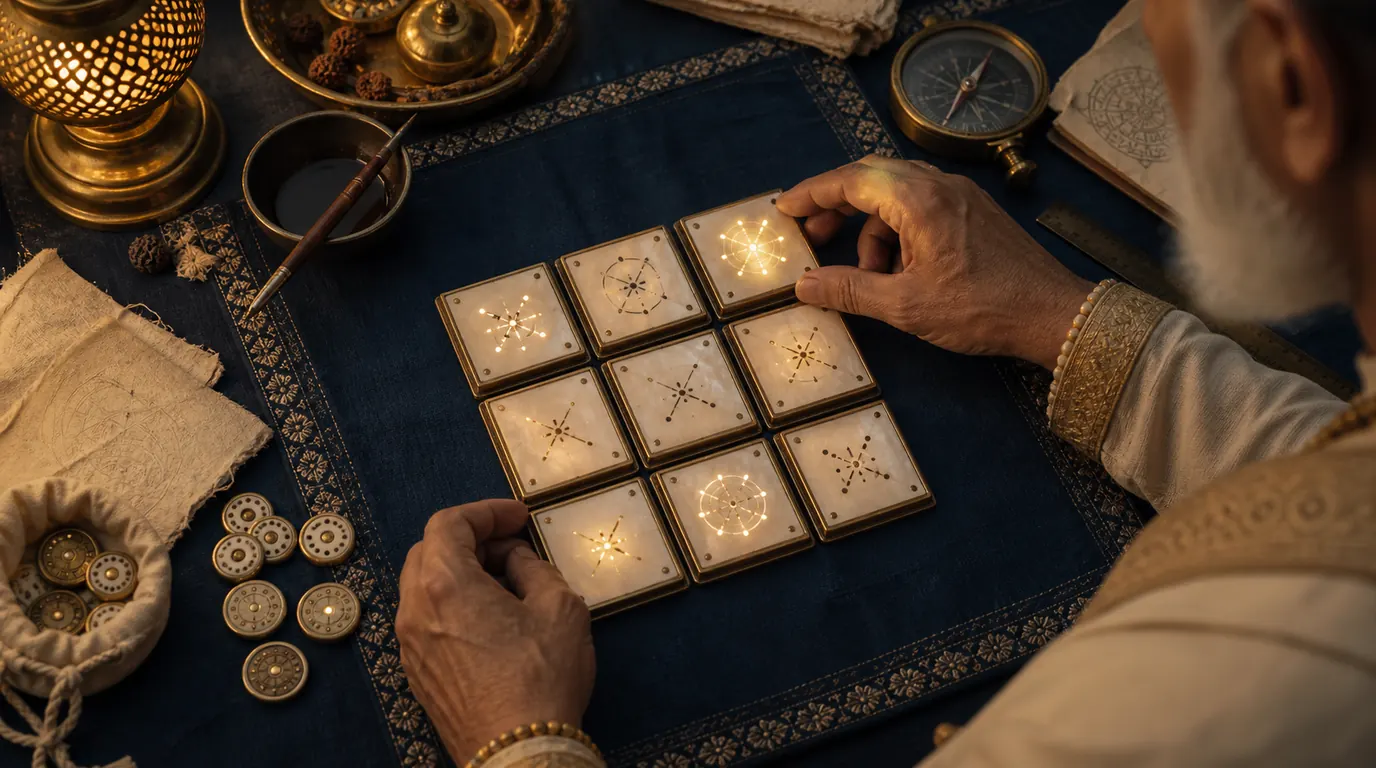
The positions never move. Only the number of times each digit appears changes:
4 | 9 | 2
3 | 5 | 7
8 | 1 | 6
For example, if a birth date contains two 1s, the bottom-centre cell shows 11. If it contains no 6, the bottom-right cell remains empty. An empty cell does not mean that a person lacks a quality forever, and a repeated digit is not automatically better than a single digit.
How Swarn Siddhi builds the grid
- Write the full birth date as DDMMYYYY. The same calendar date produces the same digit set even if you normally display it in another order.
- Remove zeroes. A Lo Shu Grid uses positions 1 through 9, so zero has no cell and is not counted.
- Calculate the Driver number. Also called Mulank, this is the birth day reduced to one digit.
- Calculate the Conductor number. Also called Bhagyank, this comes from the full birth date total and is reduced to one digit for grid placement.
- Add the Driver and Conductor to the date digits. Then count how often each number from 1 to 9 occurs.
Methods vary between numerology schools. Some readers build a grid from the date digits alone, while others add one or both core numbers. Swarn Siddhi includes both Driver and Conductor, so compare results only after checking which convention a calculator uses.
A worked example: 14 August 1992
Written as 14-08-1992, the non-zero date digits are 1, 4, 8, 1, 9, 9 and 2. The Driver number is 5 because 1 + 4 = 5. The full date adds to 34, so the Conductor number is 7 because 3 + 4 = 7. Adding 5 and 7 gives the final list: 1, 4, 8, 1, 9, 9, 2, 5 and 7.
4 | 99 | 2
- | 5  | 7
8 | 11 | -
In this example, 1 and 9 repeat, while 3 and 6 are missing. The top row is complete. The middle and bottom rows are partial because each lacks one number. That is the observable result; any meaning attached to it comes from numerology tradition rather than from the arithmetic itself.
How repeated, present and missing numbers are read
A number appearing once
A single occurrence is usually read as a quality that is available without dominating the grid. It is neither weak nor unusually strong. How that quality appears in real life still depends on learning, habits, relationships and circumstances.
A number appearing more than once
Repeated numbers are commonly described as an emphasis. In the example, repeated 1 and 9 invite the reader to examine the themes assigned to those numbers. An emphasis can be useful or overused; repetition should not be translated into a guaranteed talent, success or character trait.
A missing number
A missing number is traditionally treated as an area for conscious practice. It is not a defect, punishment or forecast of failure. For a missing number, use the suggested theme as a question: "Would a small habit in this area help me?" Keep the practice only if it is realistic and useful.
The three horizontal planes
Many Lo Shu readers group each horizontal row into a plane:
- Mind plane (4-9-2): traditionally associated with thought, planning and how ideas are organised.
- Emotional plane (3-5-7): used to reflect on expression, emotional balance and inner response.
- Practical plane (8-1-6): associated with action, routine and turning intention into something concrete.
A complete plane has all three numbers present. A partial plane has one or two, and a missing plane has none. These labels describe the grid, not a person's intelligence, emotional health or practical ability. Diagonal and vertical combinations are also used by some schools, but interpretations and names differ, so they should be explained rather than presented as universal rules.
How to use your result constructively
- Start with the counts. Confirm the birth date, Driver and Conductor before reading any interpretation.
- Choose one observation. Look at one repeated number, one missing number or one plane instead of trying to act on the entire grid.
- Compare it with real evidence. Ask whether the theme fits your behaviour across several situations, not just one memorable event.
- Turn it into a small experiment. Try a calendar reminder, communication practice or budgeting routine for a few weeks and judge it by its actual effect.
- Discard what is not useful. A numerology label should not override your experience or pressure you into a decision.
You can create your Lo Shu Grid with the public numerology calculator. The result shows the source numbers and counts, so you can check the calculation before reading the guidance.
What the grid cannot tell you
A Lo Shu Grid cannot diagnose physical or mental health, measure intelligence, select a career, prove relationship compatibility or guarantee a future result. It also cannot account for the many social, cultural and personal experiences that shape a life. For medical, legal, financial or mental-health decisions, use qualified professional advice and evidence relevant to the decision.
Even within numerology, the grid is only one method. Driver, Conductor and name-based systems answer different questions and may use different rules. Treat a combined reading as several perspectives, not as more certainty.
Frequently asked questions
Is a missing number bad?
No. It means that digit did not occur under the chosen calculation method. Numerologists may use it as a development prompt, but it does not establish a weakness or predict an event.
Is a repeated number always lucky?
No. Repetition means emphasis in this system. The associated behaviour may be helpful in one context and excessive in another.
Why does another calculator show a different grid?
First check the entered date. Then check whether the other method adds the Driver and Conductor numbers or uses only birth-date digits. A stated convention is more useful than assuming one unexplained result is correct.
Can two people with the same birthday be different?
Yes. They will share the same date-based grid, but they do not share every experience, relationship, opportunity or decision. That is a clear reason not to treat the grid as a complete description of a person.
Now try it on your own numbers
This guide explains the method. Open plot your own Lo Shu grid to run it — the page shows its working, so you can check every step against what you have just read rather than taking the result on trust.