What is Ekadashi parana?
Parana is the formal end of the Ekadashi fast, kept on Dwadashi, the lunar day after Ekadashi. The word means completing, or crossing over. Tradition treats it as part of the vrat, not an afterthought: a fast broken at the wrong time, or not broken within Dwadashi at all, is described in the rule books as incomplete.
So "Ekadashi parana time today" has a precise answer. It is a window on one particular morning, worked out from that day's sunrise and from when the Dwadashi tithi begins and ends. It is not a fixed clock time, and it is not the same in every city. The Ekadashi calendar gives that window for every fast of the year, and the live example on this page shows the next one for New Delhi.

The four rules for the parana window
Almanacs that follow the dharmashastra digests, such as the Nirnaya Sindhu and the Dharma Sindhu, apply four rules. Vaishnava calendars, which follow the Hari Bhakti Vilasa, share the same core.
- After sunrise on the day after the fast. Parana is a daytime act. In the ordinary case you do not break the fast at night or before sunrise.
- Within Dwadashi. Break the fast while the Dwadashi tithi is still running. Once Trayodashi begins, the proper time has passed.
- Not during Hari Vasara. Hari Vasara is the first quarter of the Dwadashi tithi. Even if the sun is up, you wait for it to end.
- Prefer the morning, avoid midday. The best time is pratahkala, the first fifth of the daylight. Madhyahna, the middle fifth, is avoided. If the morning is missed, the fast is broken after madhyahna is over.
Put together: the window opens at sunrise or when Hari Vasara ends, whichever is later. It closes when pratahkala ends or when Dwadashi ends, whichever comes first. When Hari Vasara runs past the whole morning, the window moves to the afternoon, after madhyahna.
What Hari Vasara is, and how it is worked out
Hari Vasara is the first quarter of the Dwadashi tithi. A tithi is not a fixed 24 hours. It is the time the Moon takes to gain 12 degrees on the Sun, which can be anything from about 20 to about 27 hours. So Hari Vasara is a quarter of whatever that particular Dwadashi lasts.
An invented example shows the arithmetic. Suppose Dwadashi begins at 2:00 AM and ends 24 hours later. A quarter of 24 hours is 6 hours, so Hari Vasara runs from 2:00 AM to 8:00 AM. If sunrise is at 6:30 AM, the window cannot open at sunrise. It opens at 8:00 AM, when Hari Vasara ends, and closes when pratahkala does.
When Dwadashi begins in the evening or around midnight, Hari Vasara usually ends before dawn and the window simply starts at sunrise. When Dwadashi begins in the small hours, Hari Vasara can stretch past the whole morning, which is why some Ekadashis have an afternoon parana. The Ekadashi calendar works this out for every fast and says which case applies.
Pratahkala and madhyahna: the five parts of the day
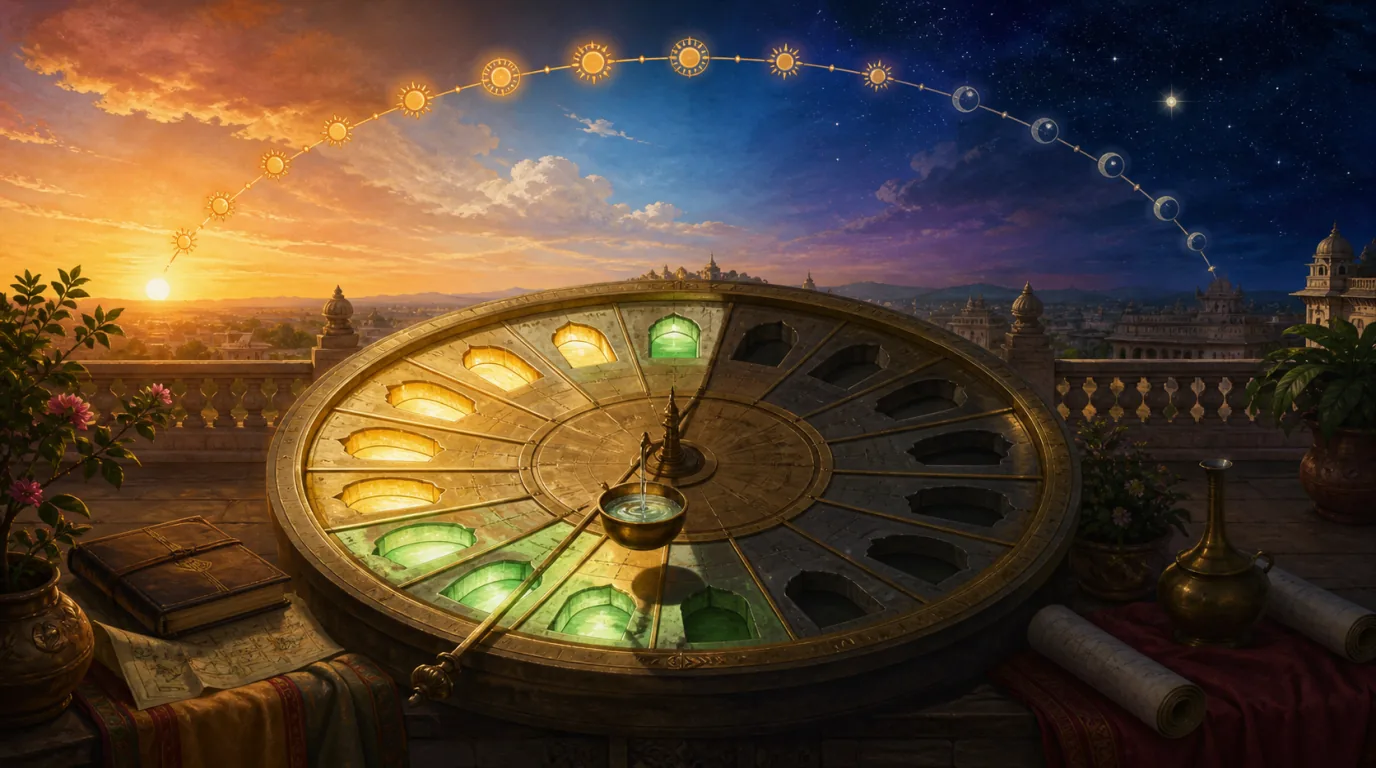
Traditional timekeeping divides the daylight, from sunrise to sunset, into five equal parts: pratahkala (morning), sangava, madhyahna (midday), aparahna (afternoon) and sayahna (evening). Their length changes with the season. On a 12-hour day each part lasts 2 hours 24 minutes; on an 11-hour winter day it lasts 2 hours 12 minutes.
Parana belongs in pratahkala, early on Dwadashi. The texts that set the rule say madhyahna is not the time for it, so an almanac will sometimes show no window at all in the late morning and then a window that starts after midday. That is the rule working as intended, not an error.
When Dwadashi ends before sunrise
Sometimes Dwadashi is short and both begins and ends between two sunrises. Then there is no Dwadashi morning to break the fast in, and almanacs handle it in different ways:
- Many Smarta almanacs say that when Dwadashi has already ended by sunrise, the fast is broken after sunrise anyway. The rule about staying within Dwadashi cannot be met, so it lapses.
- Some Smarta lists move the fast itself a day earlier in such years, so that there is still a Dwadashi sunrise for the parana.
- Vaishnava calendars give great weight to ending the fast within Dwadashi. When it is very short they may publish a very early window, and some devotees break the fast in it with a little water or charanamrit.
Our Ekadashi pages do not invent a window in these years. They say plainly that the usual morning window does not apply, and leave the choice to your family's tradition or your priest.
Smarta and Vaishnava (ISKCON) Ekadashi days
The parana depends on the day you fasted, and the two main traditions do not always fast on the same day.
- Smarta calendars, which most households and almanacs follow, take the tithi running at sunrise. The day whose sunrise falls in Ekadashi is the fast day.
- Vaishnava calendars, including ISKCON and the Gaudiya tradition, check the tithi at arunodaya, the 96 minutes before sunrise. If Dashami is still running then, the Ekadashi is called viddha (pierced) and the fast moves to the next day.
When Ekadashi holds two sunrises, almanacs also differ on which of the two days a household should keep. The result is that a Vaishnava fast, and therefore its parana, can fall a day after the Smarta one. Follow the calendar of your own tradition. ISKCON temples publish calendars for their own cities, and our named Ekadashi pages show the Smarta day, the Vaishnava day and the parana for each fast.
How to break the Ekadashi fast
Customs vary by family and region, but most follow a simple pattern:
- Bathe, and offer a short prayer or the food to the deity before you eat.
- Begin with something light: water, a tulsi leaf, charanamrit or a little prasad.
- Eat a simple, sattvic meal. Many traditions include rice or another grain at parana, since grains were given up on Ekadashi.
- Do it inside the window. If you cannot, break the fast as close to it as you can while Dwadashi is still running.
After a Nirjala Ekadashi, when even water was skipped, start with water and eat slowly. If you have diabetes, are pregnant, take regular medicines or live with any medical condition, talk to your doctor about how you fast and how you break the fast. A partial fast, on fruit or one meal, is an accepted form of the vrat in many families.
Parana time for a named Ekadashi
Each of the 24 yearly Ekadashis has a name, set by its lunar month and paksha, and an adhika (extra) month adds two more. If you are looking for the parana time of one particular Ekadashi, open its page: it shows that year's date, the tithi window, the Smarta and Vaishnava days, and the parana for your city.
| Lunar month (amanta) | Shukla paksha Ekadashi | Krishna paksha Ekadashi |
|---|---|---|
| Chaitra | Kamada Ekadashi | Varuthini Ekadashi |
| Vaishakha | Mohini Ekadashi | Apara Ekadashi |
| Jyeshtha | Nirjala Ekadashi | Yogini Ekadashi |
| Ashadha | Devshayani Ekadashi | Kamika Ekadashi |
| Shravana | Shravana Putrada Ekadashi | Aja Ekadashi |
| Bhadrapada | Parivartini Ekadashi | Indira Ekadashi |
| Ashwin | Papankusha Ekadashi | Rama Ekadashi |
| Kartika | Dev Uthani Ekadashi | Utpanna Ekadashi |
| Margashirsha | Mokshada Ekadashi | Saphala Ekadashi |
| Pausha | Pausha Putrada Ekadashi | Shattila Ekadashi |
| Magha | Jaya Ekadashi | Vijaya Ekadashi |
| Phalguna | Amalaki Ekadashi | Papmochani Ekadashi |
| Adhika (extra) month | Padmini Ekadashi | Parama Ekadashi |
The month names above follow the amanta reckoning used in South and West India. In the purnimanta reckoning used across most of North India, each Krishna paksha Ekadashi carries the next month's name. Rama Ekadashi, for example, is in Ashwin in one reckoning and in Kartika in the other. The fast falls on the same day either way.
Why parana times differ between apps and cities
- Sunrise. The window starts from local sunrise, which differs by many minutes across India and by hours across the world.
- Hari Vasara. Some apps print only a morning window and ignore Hari Vasara. On the days when it runs late, that puts the window inside the very period the rule excludes.
- The fast day. Smarta and Vaishnava calendars, and the two-sunrise cases, can put the fast on different days.
- Rounding. A difference of a minute or two usually comes from rounding or from how sunrise is defined, not from a different rule.
Our pages compute each window with the Swiss Ephemeris for the city you choose and state which rule produced it. The daily Panchang shows when Dwadashi begins and ends on any day.
Frequently asked questions about Ekadashi parana
Can I break the Ekadashi fast at night?
Not under the usual rule. Parana is kept after sunrise on Dwadashi. Eating on Ekadashi night ends the vrat early instead of completing it.
What if I miss the parana window?
Break the fast as soon as you can while Dwadashi is still running. If Dwadashi has also ended, most families simply break the fast then. Do not stretch the fast into hardship.
Why is the parana in the afternoon this time?
Because Hari Vasara, the first quarter of Dwadashi, runs past the morning window. The rule is then to wait until madhyahna (midday) is over and break the fast in the afternoon.
Is parana time the same in every city?
No. The window starts from local sunrise and depends on when Dwadashi begins, so it can differ by many minutes between Indian cities and by hours abroad. Check the window for your own city.
Is the parana rule different for Nirjala Ekadashi?
The timing rules are the same. Because no water is taken during a Nirjala fast, it is wise to begin the parana with water and eat lightly.
Do I need to do parana if I kept only a partial fast?
Yes, in most traditions. Whether you fasted fully, on fruit or with one meal, the vrat is completed by breaking it on Dwadashi in the parana window.