What is a sankalp?
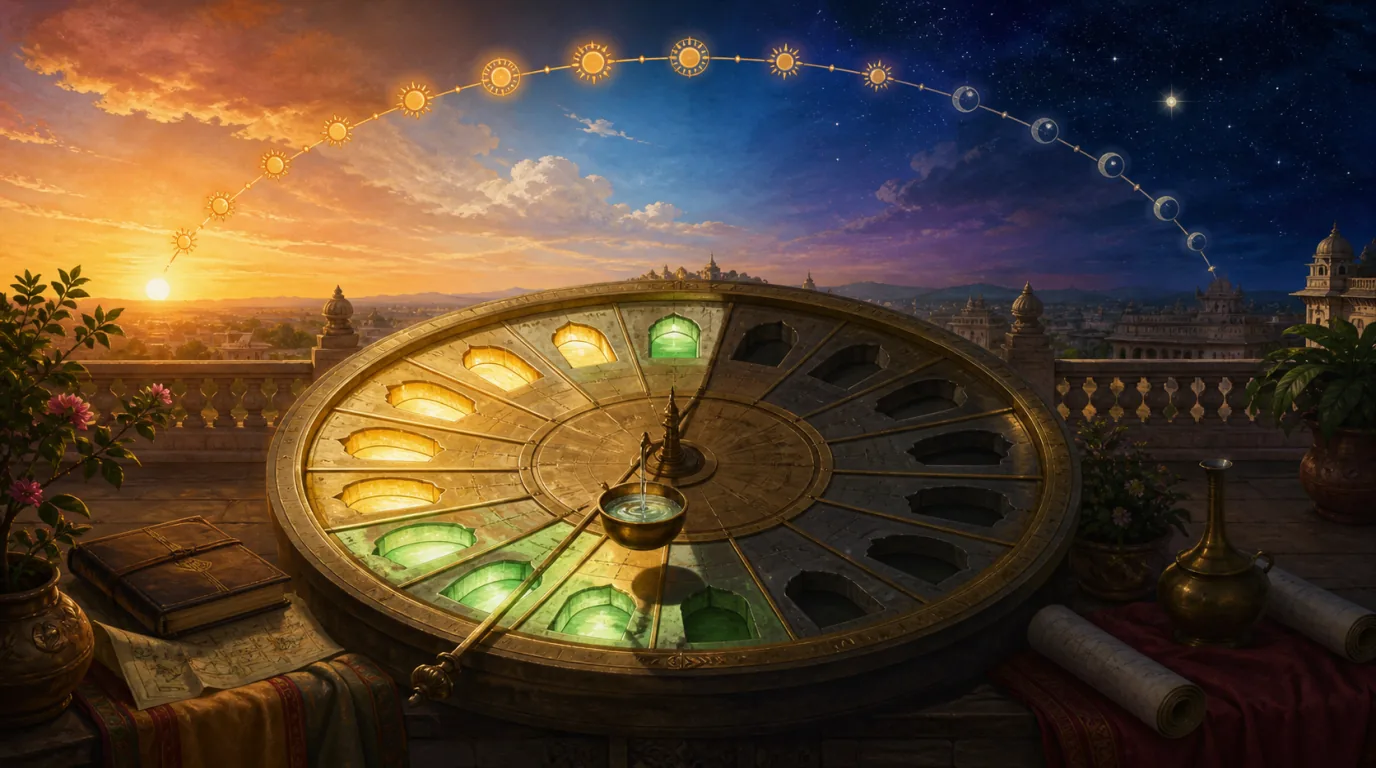
A sankalp (sankalpa) is a spoken resolve that opens a puja, vrat or act of charity: it states who is acting, where, when, for what purpose, and what will be done. The word means a firm intention. It is usually said with a little water in the right palm, often with rice grains, a flower or a coin, and the water is released at the end.
The sankalp is what makes a ritual specific. Without it, a puja is general devotion; with it, the act is tied to one person, one place and one moment. That is why the mantra is full of blanks. Some, such as your name and gotra, never change. Others, such as the tithi and the nakshatra, change every day, and they come from the panchang.
The version below is the common North Indian form found in household puja manuals. Regional forms differ in wording, and the last section of this guide notes the main differences. The sankalp opens the ritual; the prayers that follow are in the mantra library, and the festival and vrat dates are in the vrat and tyohar calendar.

The sankalp mantra in Sanskrit
The words in square brackets are the blanks you fill in.
ॐ विष्णुर्विष्णुर्विष्णुः।
श्रीमद्भगवतो महापुरुषस्य विष्णोराज्ञया प्रवर्तमानस्य अद्य श्रीब्रह्मणो द्वितीयपरार्धे श्रीश्वेतवाराहकल्पे वैवस्वतमन्वन्तरे अष्टाविंशतितमे कलियुगे कलिप्रथमचरणे
जम्बूद्वीपे भरतखण्डे भारतवर्षे [नगर] नगरे
[संवत्सर] नाम संवत्सरे [अयन] अयने [ऋतु] ऋतौ [मास] मासे [पक्ष] पक्षे [तिथि] तिथौ [वार] वासरे [नक्षत्र] नक्षत्रे
[गोत्र] गोत्रः [नाम] नामाहं [देवता] प्रीत्यर्थं [कर्म] करिष्ये।
Sankalp mantra transliteration
Om Vishnur Vishnur Vishnuh.
Shrimad Bhagavato Mahapurushasya Vishnor ajnaya pravartamanasya adya Shri Brahmano dvitiya parardhe Shri Shveta Varaha kalpe Vaivasvata manvantare ashtavimshatitame Kaliyuge Kali prathama charane
Jambudvipe Bharata khande Bharata varshe [city] nagare
[samvatsara] nama samvatsare, [ayana] ayane, [ritu] ritau, [month] mase, [paksha] pakshe, [tithi] tithau, [weekday] vasare, [nakshatra] nakshatre,
[gotra] gotrah [name] nama aham [deity] prityartham [ritual] karishye.
What the sankalp mantra means
Read as one sentence, the mantra places the speaker in time and space, from the largest scale down to the present moment, and then states the intention.
- Om Vishnur Vishnur Vishnuh. Om, and the name of Vishnu said three times, as an invocation.
- Shrimad Bhagavato … pravartamanasya. "Under the command of the glorious Lord Vishnu, the Supreme Person, by which the world runs."
- Adya Shri Brahmano dvitiya parardhe. "Today, in the second half of Brahma's life." Each half is a parardha.
- Shveta Varaha kalpe, Vaivasvata manvantare. "In the kalpa (day of Brahma) called Shveta Varaha, in the age of the seventh Manu, Vaivasvata."
- Ashtavimshatitame Kaliyuge, Kali prathama charane. "In the Kali Yuga of the 28th great cycle of ages, in the first quarter of the Kali Yuga."
- Jambudvipe Bharata khande Bharata varshe … nagare. "On the continent of Jambudvipa, in the land of Bharata, in the city of …." Some versions add the region, such as Aryavarta.
- The calendar blanks. "In the year named …, in the … half of the Sun's course, in the … season, in the month of …, in the … fortnight, on the … tithi, on …day, under the … nakshatra."
- Gotrah … nama aham … prityartham … karishye. "I, … of the … gotra, will perform … for the pleasure of …."
The large time scales are fixed and are the same for everyone today. Only the place, the calendar blanks and the personal details change.
How to fill in each blank
| Blank | What it is | Where to find it |
|---|---|---|
| nagare | The city, town or village where you are doing the puja. | Your own location. |
| nama samvatsare | The name of the year in the 60-year cycle of samvatsaras. | The panchang's year line. North and South Indian almanacs name the same year differently. |
| ayane | Uttarayana, the Sun's northward half from Makar Sankranti, or Dakshinayana, the southward half. | The panchang. |
| ritau | One of the six seasons, two lunar months each: Vasanta, Grishma, Varsha, Sharad, Hemanta and Shishira. | The panchang. |
| mase | The lunar month, such as Kartika or Margashirsha. | The panchang. Use the reckoning of your region (see below). |
| pakshe | Shukla (waxing) or Krishna (waning). | The panchang. |
| tithau | The lunar day, from Pratipada to Purnima or Amavasya. | The panchang, which also gives the time it ends. |
| vasare | The weekday, in its Sanskrit form. | The table below. |
| nakshatre | The nakshatra the Moon is in. | The panchang, which also gives the time it changes. |
| gotrah | Your family lineage, named after a rishi. | Your family. If it is not known, Kashyapa gotra is the traditional default. |
| nama aham | Your own name. | — |
| prityartham … karishye | The deity the act is offered to, and the act itself, such as a puja, a vrat or a daan. | Your purpose. |
Every calendar value on that list is on the free daily Panchang for your city, with the time each tithi and nakshatra ends. For just those two, today's tithi and today's nakshatra are on pages of their own. The live example on this page fills them all in for New Delhi today.
Today's date in the sankalp: four things to check
Most mistakes in a sankalp come from the calendar blanks, not from the Sanskrit. Four checks prevent them.
- Use the panchang for your own city. The tithi and nakshatra change at the same instant everywhere, but your local clock and sunrise decide which day they fall on.
- Watch for a change during the day. A panchang lists the tithi and nakshatra at sunrise, with the time each one ends. Priests differ on which to use when the tithi changes before the puja: some use the tithi at the time of the ritual, others keep the sunrise tithi for the whole day. If your puja falls after a change, ask which your family follows.
- Use the right month reckoning. In the purnimanta reckoning used across most of North India, a month ends on Purnima. In the amanta reckoning used in the South and West, it ends on Amavasya. During Krishna paksha the two give different month names for the same day, so say the one your region uses.
- Use the right year name. North Indian almanacs name the year in the Vikram Samvat cycle; South Indian almanacs use the Shaka reckoning, and the two names differ. Use the one your family's panchang prints.
Weekdays and tithis in Sanskrit
The weekday blank takes the planet's name plus vasare:
| Weekday | In the sankalp |
|---|---|
| Sunday | Ravi vasare (रविवासरे) |
| Monday | Soma vasare (सोमवासरे) |
| Tuesday | Bhauma or Mangala vasare (भौमवासरे) |
| Wednesday | Budha vasare (बुधवासरे) |
| Thursday | Guru vasare (गुरुवासरे) |
| Friday | Shukra vasare (शुक्रवासरे) |
| Saturday | Shani vasare (शनिवासरे) |
Strictly, the tithi takes a Sanskrit locative ending before tithau, as in Ekadashyam tithau. Many families simply say the tithi's name followed by tithau, and priests accept both. The correct forms are:
| Tithi | Before "tithau" |
|---|---|
| Pratipada | Pratipadayam (प्रतिपदायां) |
| Dwitiya | Dvitiyayam (द्वितीयायां) |
| Tritiya | Tritiyayam (तृतीयायां) |
| Chaturthi | Chaturthyam (चतुर्थ्यां) |
| Panchami | Panchamyam (पञ्चम्यां) |
| Shashthi | Shashthyam (षष्ठ्यां) |
| Saptami | Saptamyam (सप्तम्यां) |
| Ashtami | Ashtamyam (अष्टम्यां) |
| Navami | Navamyam (नवम्यां) |
| Dashami | Dashamyam (दशम्यां) |
| Ekadashi | Ekadashyam (एकादश्यां) |
| Dwadashi | Dvadashyam (द्वादश्यां) |
| Trayodashi | Trayodashyam (त्रयोदश्यां) |
| Chaturdashi | Chaturdashyam (चतुर्दश्यां) |
| Purnima | Purnimayam (पूर्णिमायां) |
| Amavasya | Amavasyayam (अमावस्यायां) |
The month and the nakshatra are simpler: the name followed by mase or nakshatre, as in Kartika mase or Rohini nakshatre.
Gotra, name and purpose
The last line is the personal part. Say your gotra, then your name followed by aham ("I"). Many printed manuals add a traditional suffix after the name, and the version said by a woman uses feminine word endings. Your family priest or puja manual will have the exact form your tradition uses.
The purpose comes last. A simple, complete ending names the deity and the act: Shri Ganapati prityartham pujanam karishye, "I will perform the worship for the pleasure of Shri Ganapati." Many sankalpas also state a wish for the family's welfare before the act. Keep the purpose honest and specific; the sankalp is a commitment, not a bargain.
If you are pressed for time, many families use a shortened sankalp that keeps the essentials: the invocation, adya ("today"), the tithi, the gotra, the name and the act. A full sankalp is preferred for a vrat, a major festival puja or a daan.
Regional differences in the sankalp
- Opening words. South Indian sankalpas often begin with a prayer for the removal of faults and the phrase shubhe shobhane muhurte ("at this auspicious moment") before the time scales.
- Place. Many South Indian versions locate the speaker relative to Mount Meru, as in Meroh dakshine parshve, "on the southern side of Meru".
- Year name. North Indian sankalpas use the Vikram Samvat cycle; South Indian and Maharashtrian ones use the Shaka reckoning, which gives a different name for the same year.
- Month. Purnimanta in most of the North, amanta in the South and West, as described above.
None of these is more correct than the others. Use the form your family and your priest use, and fill the calendar blanks from a panchang for your own city.
Frequently asked questions about the sankalp mantra
Which samvatsara name should I use in the sankalp?
Use the name your family's panchang prints. North Indian almanacs follow the Vikram Samvat cycle and South Indian ones the Shaka reckoning, and the two give different names to the same year.
What if I do not know my gotra?
Many families say Kashyapa gotra when the lineage is not known, following the tradition that all beings descend from the sage Kashyapa. If your family has a custom of its own, follow it.
Do I need a priest to say the sankalp?
No. Anyone may take a sankalp for their own puja or vrat. A priest helps with the exact wording and pronunciation, especially for a large ritual or one done for someone else.
Can I say the sankalp in Hindi or English?
Yes. The Sanskrit form is traditional, but the purpose of a sankalp is a clear, sincere intention. Many families say it in their own language, keeping the date, place, gotra and name.
Which tithi should I use if it changes during the puja?
Practice differs. Some priests use the tithi running at the time of the ritual, others the tithi at sunrise for the whole day. Check the change time on the panchang and follow your family's custom.
Why is water held in the hand during the sankalp?
Water is the traditional witness to a vow. It is held in the right palm while the intention is spoken and released at the end, to mark the resolve as made.